
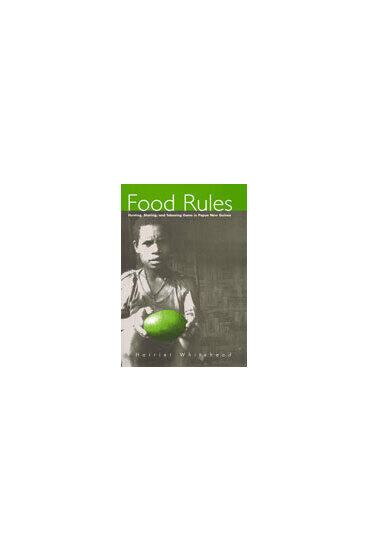
Food Rules
Hunting, Sharing, and Tabooing Game in Papua New Guinea
Presents a radically new picture of the role of social actors in the making of culture
Description
In the two tiny Seltaman villages, situated in a remote corner of Papua New Guinea's central mountains, food rules divide the social world into distinct categories--men of different initiation statuses, women, children, and the elderly of both sexes. Ostensibly dictated by the ancestors, these eating rules are marked both by a mysterious stability and by equally mysterious sudden variations.
Over the course of repeated visits to the Seltaman, Harriet Whitehead was caught up by the need to understand the kinds of eating restrictions that appear in so many societies around the world. Working against the strictly symbolic interpretive approach that has dominated the discussion of "food taboos" in the anthropological literature, Whitehead argues instead that food rules are the outcropping of diverse, dynamically interacting causes. With remarkable lucidity Whitehead teases out the multiple and sometimes conflicting strands of causality in the Seltaman case, giving us both a profoundly insightful account of Papuan village life and a new way of understanding culture.
A strikingly original scholar, Whitehead turns to dynamical systems theory and the "modularity of mind" school of psychology to launch a penetrating critique of anthropology-as-usual and to set us on a new path toward understanding human lifeways and human performances.
Harriet Whitehead is a research associate at Duke University, pursuing a study in cross-cultural child development. She is the author of Renunciation and Reformulation: A Study of Conversion in an American Sect, and the coeditor/author with Sherry B. Ortner of Sexual Meanings: The Cultural Construction of Gender and Sexuality.
Harriet Whitehead is a research associate at Duke University, pursuing a study in cross-cultural child development. She is the author of Renunciation and Reformulation: A Study of Conversion in an American Sect, and the coeditor/author with Sherry B. Ortner of Sexual Meanings: The Cultural Construction of Gender and Sexuality.
Reviews
"This book offers a rich, intelligent ethnographic portrait . . . It will be essential reading for everyone interested in New Guinea as a cultural area, shaping arguments for years to come about how to best understand the cultures of the central mountain area and, to a significant extent, other parts of New Guinea."
- Eytan Bercovitch, University of Californa, Berkeley
—Eytan Bercovitch, University of Californa, Berkeley
Whitehead takes a classical question in anthropology, that of taboo and food rules, and shows how an understanding of the rules found in a particular society requires analysis of the processes implicated in and affected by those rules. What emerges is a complex story of reciprocal causality as different clusters of factors come into play. . . . This book has much to recommend it as ethnography, as a significant contribution to the understanding of food rules and taboos, and as an argument for a reorientation of the anthropological project and the ways anthropology is to be done.
- Journal of Polynesian Studies
. .. . a refreshing combination of fine-grained ethnography and ambitious efforts at analysis, theory-building, and agenda-setting.
- Journal of Ritual Studies
. . . a most fascinating, complex and in-depth analysis of the topics of food, food taboos and hunting.
- Journal of Ritual Studies