
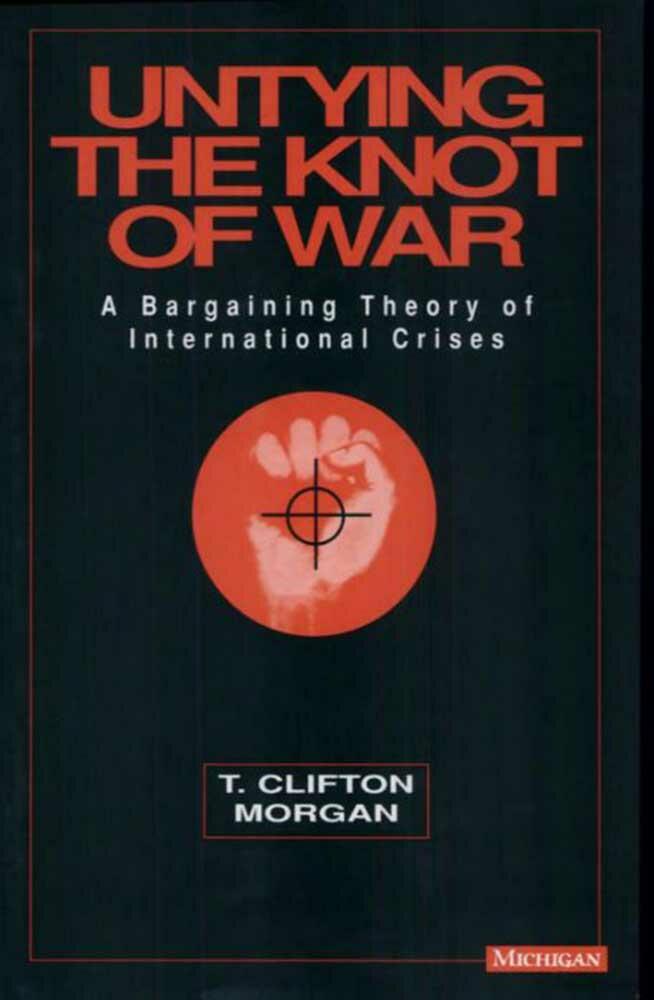
Untying the Knot of War
A Bargaining Theory of International Crises
A formal theory of why some crises end in war
Description
This book utilizes formal, spatial voting models and game-theoretic techniques to examine why certain international crises erupt into all-out wars while others resolve peacefully through diplomacy. Operating on the premise that a crisis always precedes war, Morgan develops original mathematical frameworks to show how crisis outcomes are fundamentally dictated by the specific characteristics of the bargainers, the multi-dimensional nature of the disputed issues, and the vital interventions of third-party negotiators and agenda setters. By illustrating these formal equations with historical cases, the text moves beyond rigid security-maximization arguments, providing international relations scholars with a robust, predictive framework for conflict resolution and crisis bargaining.
Reviews
Winner: American Political Science Association (APSA) 1996 Conflict Processes Section Award for Best Book on Conflict and Peace Studies
- APSA Best Book on Conflict and Peace Studies
This appealing book presents a collection of original models addressing whether, and how, an international crisis may turn into a war. . . . Untying the Knot of War is a solid introduction to what is bound to become an important and fruitful approach to crisis bargaining.
- American Political Science Review
Untying the Knot of War will challenge and inform both the casual reader and the serious researcher. . . . For students or scholars interested in the causes of war and conflict resolution, Morgan highlights the importance of crisis outcomes, bargaining, and the potentially critical role played by agenda setters and third parties.
- Mershon International Studies Review