
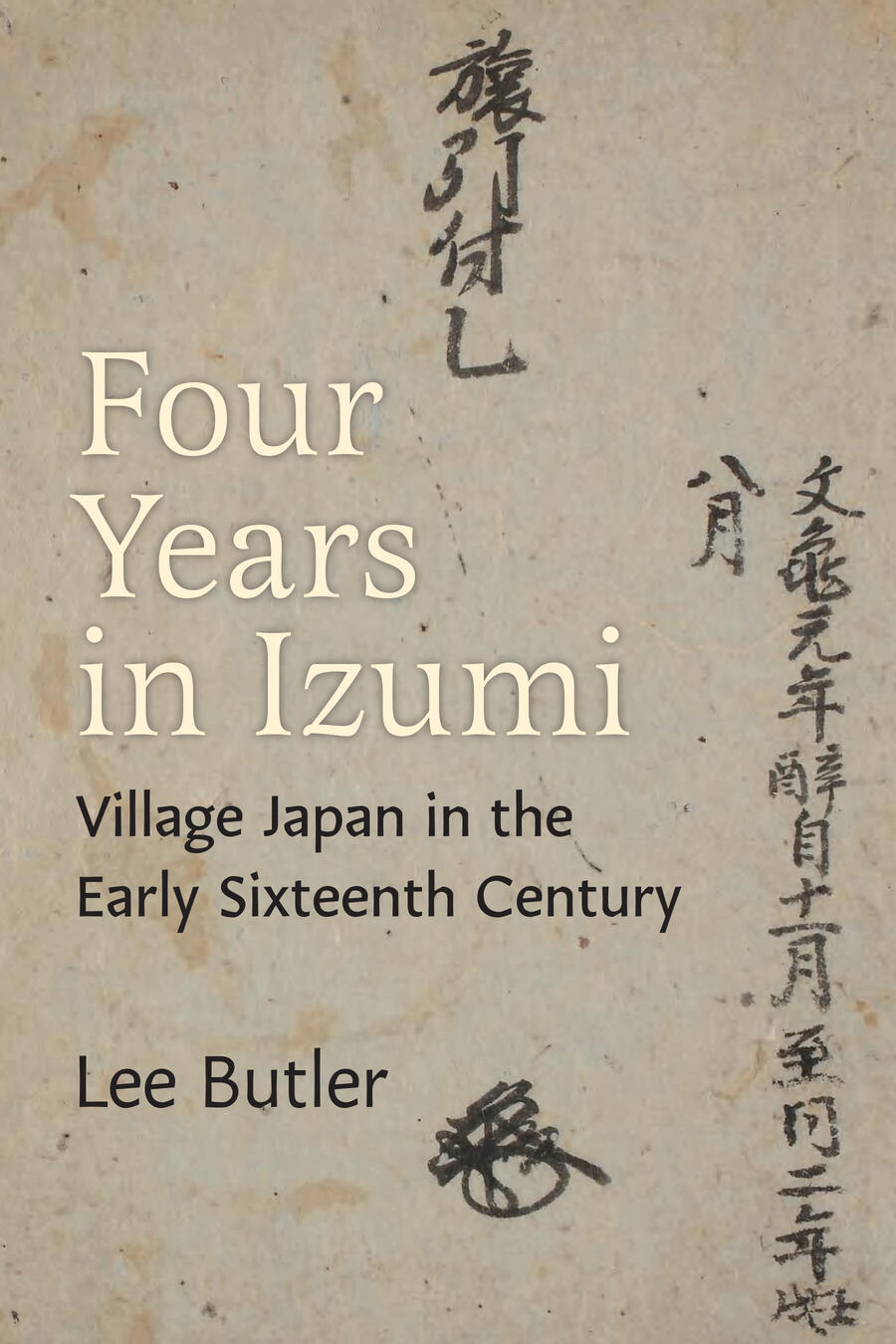
Four Years in Izumi
Village Japan in the Early Sixteenth Century
An unparalleled view of village society in Japan’s tumultuous Warring States period
Description
Four Years in Izumi takes an in-depth and critical approach to understanding Japanese village life through analysis of the diary of Kujō Masamoto, the former chancellor of the imperial court who resided briefly in one of his provincial estates from 1501 to 1504. For a high ranking courtier to travel to the countryside and manage a family estate was unheard of during the era of Sengoku, the “country at war.” The diary Masamoto kept offers a remarkably rich and vivid portrait of village Japan, which has seen no significant study in English-language scholarship.
Through extensive examination of the diary and close and critical reading of it and complementary sources, Lee Butler provides a window into the inner workings of late-medieval village life that challenges typical portrayals of the period. In Four Years in Izumi, we see the complexity of relations between commoners and elites in action. We also see the ways in which an estate functioned in practice at the heart of the medieval economy and local social structure.
Lee Butler is an independent scholar of late medieval and early modern Japanese history.
Reviews
“A real boon to the field, Four Years in Izumi provides a lively, intimate look at late medieval village organization and activities during a crucial time of transition in Japan.”
- Ethan Segal, Michigan State University
“Even as no more than an exploration of village life, of the tensions between proprietors, warrior authorities, and peasant communities, Four Years in Izumi would represent an important contribution to the historiography of the early Warring States period. But the book is also—uniquely in English-language scholarship—a meticulous, textured examination of one aristocratic journal, of one aristocrat’s first-person account of his struggle to make sense of a new and chaotic world, and his place within it.”
- David Spafford, University of Pennsylvania