
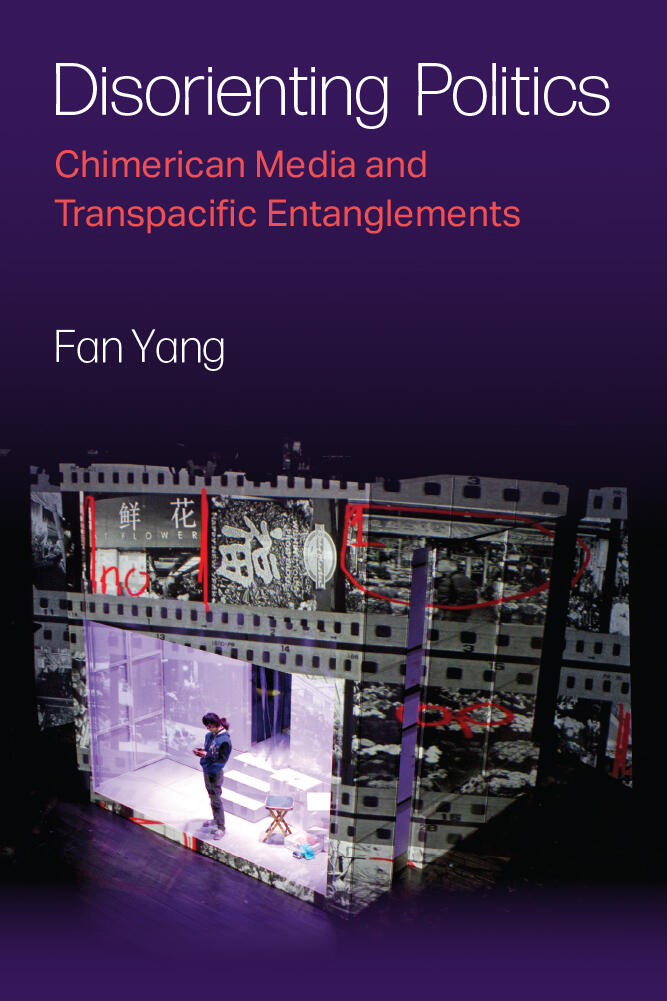
Disorienting Politics
Chimerican Media and Transpacific Entanglements
Understanding Chimerican entanglements through 21st-century media
Description
Disorienting Politics mines 21st-century media artifacts—including films like The Martian and TV/streaming media shows such as Firefly and House of Cards—to make visible the economic, cultural, political, and ecological entanglements of China and the United States. Describing these transpacific entanglements as “Chimerica”—coined by economic historians to reference the symbiosis of China and America—Yang examines how Chimerican media, originating in the US but traversing national boundaries in their production, circulation, and consumption, co-create the figure of rising China and extend a political imagination beyond the conventional ground of the nation.
Examining how Chimerican media are shaped by and perpetuate uneven power relations, Disorienting Politics argues that the pervasive tendency among wide-ranging cultural producers to depict the Chinese state as a racialized Other in American media life diminishes the possibility of engaging transpacific entanglements as a basis for envisioning new political horizons. Such othering of China not only results in overt racism against people of Asian descent, Yang argues, but also impacts the wellbeing of people of color more generally. This interdisciplinary book demonstrates the ways in which race is embedded in geopolitics even when the subject of discussion is not the people, but the (Chinese) state. Bridging media and cultural studies, Asian and Asian American studies, geography, and globalization studies, Disorienting Politics calls for a relational politics that acknowledges the multifarious interconnectivity between people, places, media, and environment.
Fan Yang is Associate Professor in the Department of Media and Communication Studies at the University of Maryland, Baltimore County (UMBC).
Reviews
"Yang provides a close and concise reading of transpacific media of value to students and researchers in Asian studies, media studies, anthropology, political science, and transpacific studies. Summing up: recommended. Advanced undergraduates through faculty."
- CHOICE
“Disorienting Politics offers a rich engagement with intriguing media forms. Yang is well-versed in the scholarship of a wide range of disciplines, from anthropology to media studies and several more in between. Yang’s wide-ranging argument is clearly presented and nicely conceived without being turgidly theorized.”
- Jennifer Hubbert, Lewis and Clark University
"By introducing race, gender, and ethnicity into discussions of national and transnational politics, the book contributes to scholarly conversations in Asian American studies and American studies. Its rich interdisciplinary engagement not only draws from but also advances existing literature across these fields.”
- Wendy Su, The Journal of Asian Studies
“Disorienting Politics will be particularly valuable for scholars and graduate students working at the intersections of media studies, cultural studies, critical race theory, and transnational communication. Those interested in postcolonial theory, Asian American studies, and political economy will find its conceptual framework especially insightful. Beyond academia, policy analysts and journalists seeking to understand how media both represent and shape U.S.-China geopolitical tensions will also find it a practical resource.”
- Narmin Gezer, International Journal of Communication