
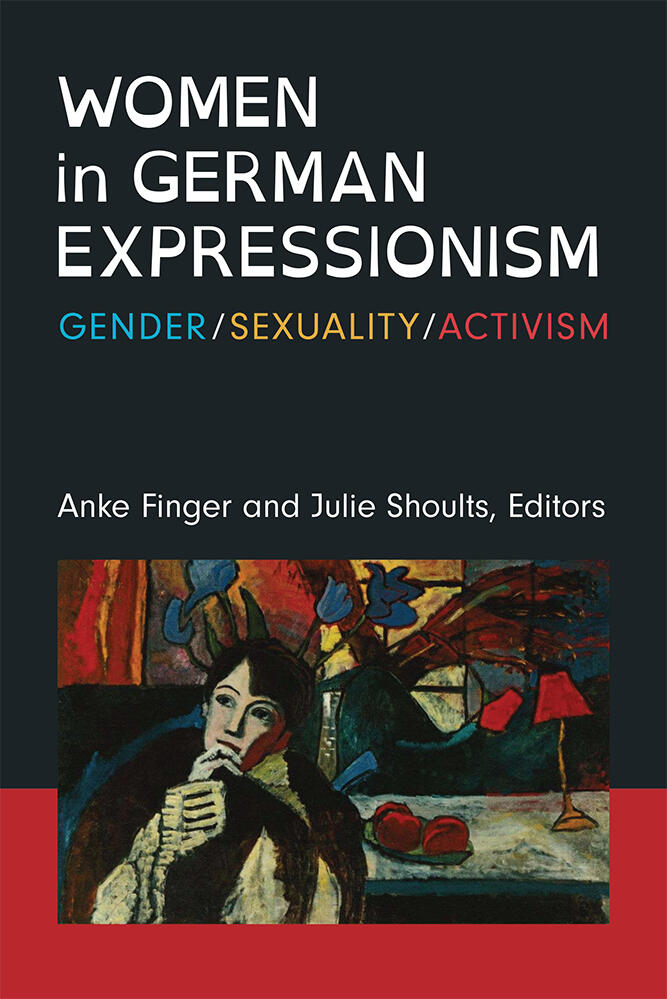
Women in German Expressionism
Gender, Sexuality, Activism
Literary scholarship questions and challenges the limited and fossilized gender narrative of German Expressionism
Description
This collection, for the first time, explores women’s self-conceptions and representations of women’s and gender roles in society in their own Expressionist works. How did women approach themes commonly considered to be characteristic of the Expressionist movement, and did they address other themes or aesthetics and styles not currently represented in the canon? Women in German Expressionism centers its analysis on gender, together with difference, ethnicity, intersectionality, and identity, to approach artworks and texts in more nuanced ways, engaging solidly established theoretical and sociohistorical approaches that enhance and update our understanding of the material under investigation. It moves beyond the masculine, “New Man,” viewpoint so firmly associated with German Expressionism and examines alternative, critical, and divergent interpretations of the changing world at the time. This collection seeks to broaden the theorization, scholarship, and reception of German Expressionism by—much belatedly—including works by women, and by shifting or redefining firmly established concepts and topics carrying only the imprint of male authors and artists to this day.
Anke Finger is Professor of German Studies, Media Studies, and Comparative Literature at the University of Connecticut.
Julie Shoults is Visiting Lecturer in German and Women's & Gender Studies at Muhlenberg College.
Reviews
"This volume does much to redress the impression that women in Expressionism were viewed first and foremost by their male colleagues...Instead they were creators, editors, activists, revolutionaries, drivers in their own right, and it's long past time to recover their legacies."
- Monatshefte
"The collection of scholarly essays in Women in German Expressionism makes a real contribution to the field of German expressionist studies through profound critical questioning of received assumptions about the field’s parameters, especially in literary expressionism, where women’s voices have generally not received the attention as visual artists in revisionist studies."
- Colin Rhodes, Art History
"This important and innovative collection of essays is a very welcome addition to recent scholarship on German and Austrian Expressionist art and literature...The editors are to be commended for compiling work from diverse disciplinary backgrounds and career stages; the number of early-career scholars represented here is cause for optimism about the future study of German Expressionism."
- Lisa Marie Anderson, The Germanic Review
"Women in German Expressionism is a welcome contribution to the scholarship on a cultural period that remains shrouded in misconceptions engendered by the surprisingly patriarchal approach to documenting its output and establishing the reasons for its importance. The authors embrace recent theoretical approaches in a manner that allows them to correct the impression that Expressionism was by and large the achievement of male authors and artists who strove to pave the way for a “new man” informed by the male attribute of “Geist” (intellect), when in fact it was simultaneously the accomplishment of women striving to infuse contemporary culture with the nurturing necessary to achieve justice and civil rights.
- Virginia L. Lewis, Studies in 20th & 21st Century Literature