
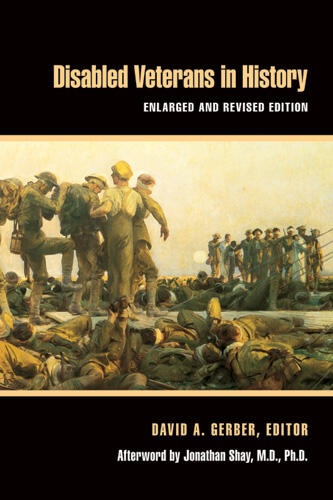
Disabled Veterans in History
Enlarged and Revised Edition
The history of disabled veterans, from Ancient Greece to the conflict in Afghanistan
Description
Disabled Veterans in History explores the long-neglected history of those who have sustained lasting injuries or chronic illnesses while serving in uniform. The contributors to this volume cover an impressive range of countries in Europe and North America as well as a wide sweep of chronology from the Ancient World to the present. The essays address the emergence of "veteran" as a political category with unique privileges and entitlements and of disabled veterans as a special project--and indeed one of the original projects--of the modern welfare state.
The introductory essay, "Finding Disabled Veterans in History," offers perhaps the first attempt at synthesizing knowledge about disabled veterans in Western societies. The other essays examine the representation of disabled veterans from Sophocles' Philoctetes to American feature films; the relations of disabled veterans to the state and society in such public policy issues as pensions, medical care, physical rehabilitation, and job retraining; and the disabled veteran's agency and experience in reentering the peacetime world. Other topics include the place of disabled veterans in societies defeated in war; the fate of disabled veterans in societies experiencing frequent changes of political regimes; the emergence of pensions and vocational rehabilitation for disabled veterans; and the abiding problem of alcohol abuse among disabled veterans.
The contributors come from a variety of disciplines, including history, physical rehabilitation, Slavic studies, sociology, communication and media, and museum studies. The book will be of interest especially to researchers in the fields of war and society, the welfare state, and disability studies, as well as those in the medical, rehabilitation, and counseling fields.
Afterword by Jonathan Shay, M.D., Ph.D.
David A. Gerber is Professor of History, State University at Buffalo. He is the author or editor of five previous books.
Reviews
"Because, as some have wryly pointed out, 'war is the most efficient way of creating disabled people,' it offers a unique view into how different coexisting ideas of disability came into conflict and how various policies for the civilian population emerged as a result. . . . [T]he volume covers a broad range of issues related to veterans in North America and Europe. Ancient Greece, sixteenth-century England, the Napoleonic Wars, the American Civil War, World Wars I and II, Americans in Vietnam, and Russians in Afghanistan together raise important questions about the body, the relationship between the home and battlefront, challenges to masculinity, the development of national identity, and collective memory, as well as the relationships among governments, policy, and self-advocacy. . . . But more than introducing readers to a little-explored corner of the past, Disabled Veterans in History forces readers to think differently about war itself. . . . If reading Disabled Veterans in History makes it clear that it would be difficult to write the history of disability without discussing war, it makes an even stronger case that it should be impossible to write the history of war without disability."
- Catherine J. Kudlick, Univ of California, Davis
—American Historical Review
" Disabled Veterans in History nicely demonstrates the possibilities for studying how societies treat men wounded in the service of the state. . . . This anthology marks an excellent beginning and the questions raised here and the sources uncovered point to the exciting possibilities for further scholarship."
- Daniel J. Wilson
—Daniel J. Wilson, H-Disability
". . . a ground-breaking collection."
- Daniel Blackie, University of Helsinki
—Daniel Blackie, University of Helsinki, Journal of American Studies, Volume 36 (2002)
"The wide thematic and chronological range of this collection, and the thorough introductory essay, make it invaluable to anyone with an interest in the history of war and medicine, the history of social policy, or of disability in general."
- Mark Harrison
—Mark Harrison, Medical History, Volume 46, No.1 (2002)