
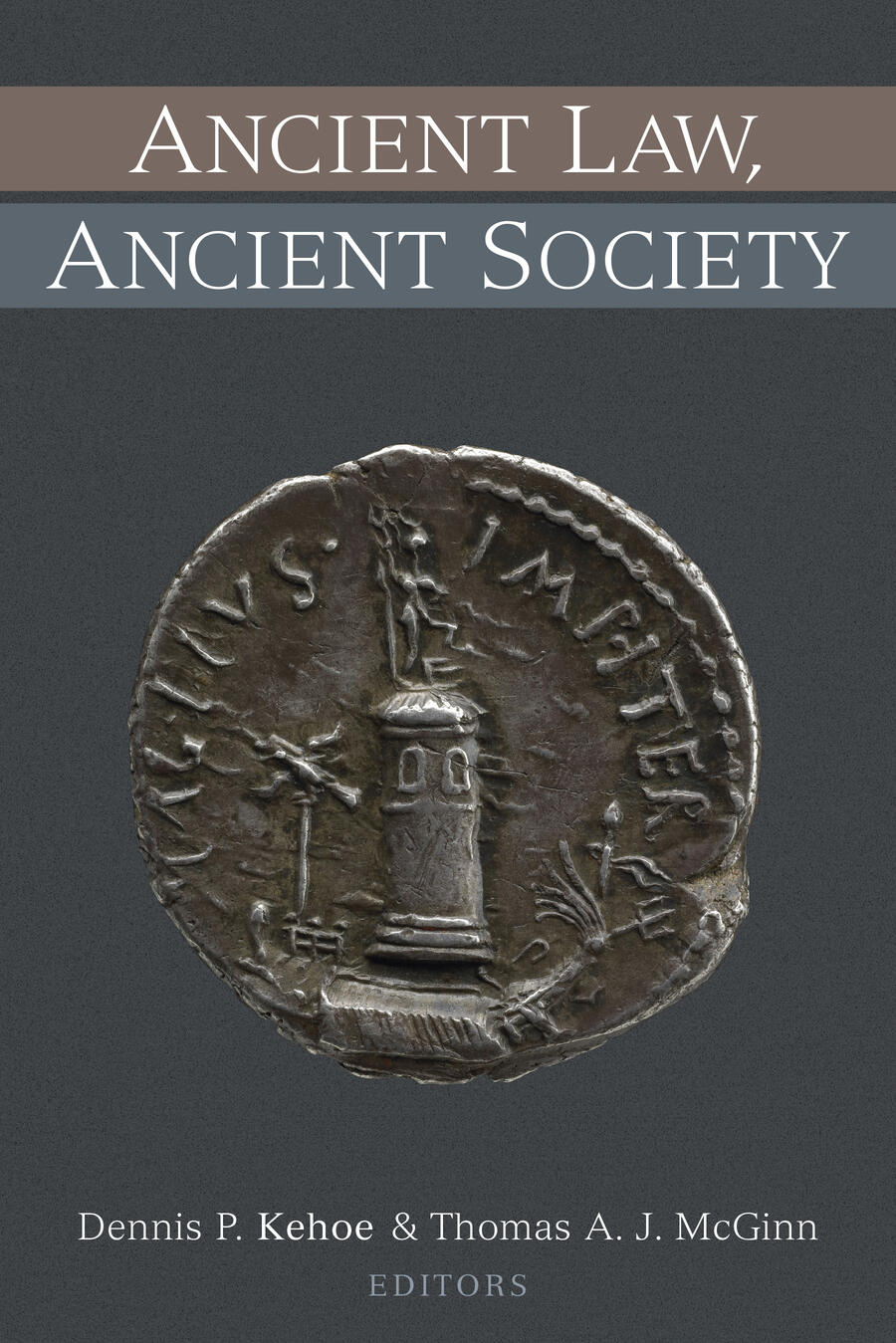
Ancient Law, Ancient Society
An engaging look at how ancient Greeks and Romans crafted laws that fit—and, in turn, changed—their worlds
Description
The essays composing Ancient Law, Ancient Society examine the law in classical antiquity both as a product of the society in which it developed and as one of the most important forces shaping that society. Contributors to this volume consider the law via innovative methodological approaches and theoretical perspectives—in particular, those drawn from the new institutional economics and the intersection of law and economics.
Essays cover topics such as using collective sanctions to enforce legal norms; the Greek elite’s marriage strategies for amassing financial resources essential for a public career; defenses against murder charges under Athenian criminal law, particularly in cases where the victim put his own life in peril; the interplay between Roman law and provincial institutions in regulating water rights; the Severan-age Greek author Aelian’s notions of justice and their influence on late-classical Roman jurisprudence; Roman jurists’ approach to the contract of mandate in balancing the changing needs of society against respect for upper-class concepts of duty and reciprocity; whether the Roman legal authorities developed the law exclusively to serve the Roman elite’s interests or to meet the needs of the Roman Empire’s broader population as well; and an analysis of the Senatus Consultum Claudianum in the Code of Justinian demonstrating how the late Roman government adapted classical law to address marriage between free women and men classified as coloni bound to their land.
In addition to volume editors Dennis P. Kehoe and Thomas A. J. McGinn, contributors include Adriaan Lanni, Michael Leese, David Phillips, Cynthia Bannon, Lauren Caldwell, Charles Pazdernik, and Clifford Ando.
Dennis P. Kehoe is Professor of Classical Studies and Andrew Mellon Professor in the Humanities at Tulane University.
Thomas A. J. McGinn is Professor of Classical Studies, History, and Law at Vanderbilt University.
Reviews
"The editors and the University of Michigan Press have produced a neatly curated collection of essays in honor of Bruce Frier...the volume is something of a showcase for the variety of approaches now current in the landscape of ancient legal studies."
- David M. Ratzan, Bryn Mawr Classical Review
"The volume can be recommended to scholars of ancient Greek and Roman law, ancient history and economic history. The contributors have succeeded in honoring Bruce Frier with an excellent series of papers, fitting the high value of his many-sided and innovative research oeuvre."
- Eva Jakab, The Journal of Roman Studies
"Each of these chapters [are] successful because these new ideas, and borrowings from other disciplines, are used alongside close source analysis. There is also an awareness of the inherent limitations in applying these ideas away from their core discipline and period...The book is an important one."
- Anthony Smart, The Classical Journal
"The scholarship of [the contributors] are textbook examples of how to engage with Continental scholarship while at the same time using modern approaches from other disciplines to further their investigations and to ask different questions about Roman law."
- Paul du Plessis, Journal of Roman Archaeology