Why Does Yellowface Persist in Twenty-First-Century Musical Theatre?
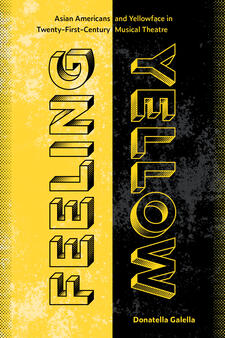
This guest author post is by Donatella Galella, author of Feeling Yellow Asian Americans and Yellowface in Twenty-First-Century Musical Theatre. The book is available in hardcover, paperback, and open access.
Last year, Darren Criss became the first Asian American to win the Tony Award for Lead Actor in a Broadway musical for his role as Oliver, a humanoid Korean robot who falls in love with another robot named Claire, in Maybe Happy Ending. One month later, the producers announced that a white actor, Andrew Barth Feldman, would replace him. The reskinning of this robot suggests the malleability of Asian and Asian American representation in contemporary musical theatre. Feldman did not wear yellow-brown bronzer nor tape up his eyes to appear stereotypically East Asian, but he still portrayed a Korean-made character with Korean-specific dramaturgy in an industry that still systemically sidelines Asian Americans. This fall, a Black actress has taken on the role of Claire full-time. Maybe Happy Ending serves as the latest high-profile example of a phenomenon I call “yellowface without yellowed faces.”
My new book Feeling Yellow: Asian Americans and Yellowface in Twenty-First-Century Musical Theatre studies how and why yellowface endures, as well as how Asian Americans and their allies have challenged this anti-Asian practice. Yellowface—the performance of Asianness by non-Asians—dates back hundreds of years, from the yellow makeup, slanted eyes, and queue of the comic Chinaman to the kimonos, shuffling feet, and giggling behind fans of Japanese maidens. After the infamous protest of Miss Saigon in the 1990s and with the rise of postracial rhetoric in the 2000s, yellowface became subtler yet pernicious nevertheless.
At the end of the interviews that I conducted for my book, I asked my subjects why they think yellowface persists in the twenty-first century and especially in musical theatre. Here, I share some of their illuminating answers that do not appear in full in the published manuscript. Actress and activist fairyprincessdiaries blogger Erin Quill commented on the pleasures of performing yellowface with postracial plausible deniability: “Well, yellowface persists because it’s ‘fun.’ It’s fun for white people ... They do it because they realize, in this day and age, it’s maybe a little boring to be white. So, they want to be somebody else. They want to be somebody more exotic. They want to have a different backstory. They want to be able to mock people without mocking them. Right? And again, it doesn’t have to be actual yellowface. It can be just behavioral, and it’s coded to us. But to the general white audience, you know, they’ll turn around and say, ‘I don’t know what you’re talking about. They were fine. They had a fan.’ I'm not saying you can’t use fans. You know? Cultures have fans. Cultures have wigs. Cultures have ways of walking and all that kind of stuff. But there is a difference as to why it persists. It persists because white people always need somebody to look down on.” Quill notes that “yellowface without yellowed faces” can entail racialized props, wigs, and movements and uphold racial hierarchy.
Playwright David Henry Hwang of M. Butterfly and Yellow Face fame similarly offered insights with cheek and comprehension: “White people seem to really like being Asian. They just love to dress up as Asians. But on a deeper level, I think it’s a reflection of the degree to which westerners and Americans still do not take the issue of racism against Asian Americans particularly seriously, and feel some ambivalence about whether we constitute a minority or not, even though obviously, numerically we do. So I think that the use of yellowface is directly proportional to the degree to which people buy the model minority myth, because we are considered kind of white adjacent or honorary white; therefore, there is less stigma about actual white people portraying us.” Hwang contends that, because many Americans consider Asian Americans to be practically white, then anti-Asian discrimination appears insubstantial. He further explained, “I think that there’s a feeling about musicals being less realistic to begin with. Which they are. Inherently, the form is more metaphorical since people don’t normally burst into song. And so … this gives people more license to do all sorts of metaphorical and theatrical things, including yellowface. Now, if you take this a step further, opera is that much more removed from reality. And opera has only recently begun to address the issue of yellowface.” Hwang points to the genre conventions of musical theatre, particularly opera, that lean toward fantasy over reality. I would add that an emphasis on singing voices—often believed to be separate from race—can make yellowface performance appear more permissible.
Feeling Yellow also tracks progressive change. In the 2010s, yellowface seemed omnipresent from musical productions to big budget films such as The Last Airbender and Ghost in the Shell. But organized pressure from social media users, bloggers, journalists, the Asian American Performers Action Coalition, and other artists and audiences called out inequities in casting and stereotypical representation. They shifted the terms for acceptability. Thanks to external protest and internal reflection, institutions like the New York Gilbert and Sullivan Players (NYGASP) amended their version of The Mikado. The company eliminated overt yellowface performance elements from Orientalist gestures to wigs, cut offensive text, cast more Asian Americans, created an Asian American advisory committee, hired an Asian American assistant director, and reenvisioned the operetta as W. S. Gilbert’s dream. Still, a mostly white cast and production team scripted and embodied imagined Asians. Case studies like The Mikado indicate the extent of change.
Leah Nanako Winkler, a playwright and screenwriter, took up the charge against yellowface in The Mikado by calling NYGASP’s Artistic Director and then calling in allies for backup on her blog. Because she believes that white people generally do not perceive yellowface as wrong, she asserted, “It’s important for us to stand up to it, even when it sucks to do.” While she received support, she also experienced intense backlash online that took a toll on her mental health. Yet Asian Americans and anti-racist allies can feel compelled to fight yellowface. Their anger, sadness, and alienation, the affects of what I theorize as “feeling yellow,” can circulate to others, moving them to understand the harms of yellowface. They channel their righteous and racialized emotions into organized protests and original performances.
Feeling Yellow intentionally highlights Asian American creative intervention, such as the Pulitzer Prize-nominated musical Soft Power by Hwang and Jeanine Tesori. In this topsy turvy version of The King and I, a Chinese theatre producer and DHH (an avatar of David Henry Hwang) navigate the United States, which has fallen into racist disrepair since the 2016 presidential election, complete with a cast of Asian Americans playing Chinese actors playing white American characters in satirical whiteface. When asked about the continuation of yellowface today, Sam Pinkleton, who co-choreographed Soft Power and went on to direct Oh, Mary!, charged, “The great crimes of musical theatre, the blood is usually on the hands of ‘good white liberals’ … Power works in ugly ways. And the folks in power want to get an A plus on their EDI checklist for their musical while doing none of the actual work. And the bodies who are asked—I cannot tell you how emotional the collaboration with our cast was. I as the naïve white guy was shocked at how many of our cast members were like, ‘I’ve never been asked to do any of this stuff on stage.’ Someone was like, ‘All I have ever done on stage is fucking bow. And I do that because I need health insurance.’ … I think that people think that the work stops with casting. And unfortunately, because of capitalism and because of power, the bodies who are asked to do the things on stage frequently do not have the power to speak up to advocate for themselves. They don’t have support systems in the room.” Pinkleton connects yellowface to uneven power dynamics. He suggests that casting Asian Americans in Asian roles is insufficient for racial justice, because they deserve to play protagonists, not just stereotypical sidekicks. He implicates fellow white artists who can do better.
My book places center stage Asian Americans and ongoing problems with yellowface, ultimately inviting all of us to serve as those support systems in the room. In solidarity, we can maybe work toward a happy ending to structural anti-Asian racism.