Q&A with James Parisot
Author of Class Politics and the Creation of the American State

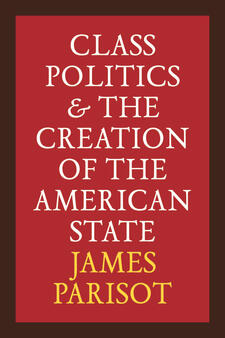
This guest author post is a Q&A with James Parisot, author of Class Politics and the Creation of the American State. The book is now available in Hardcover, Paperback, and open access.
What inspired you to write this book?
I suppose like most book projects, a convergence of several forces. Academically, after many years of working part time as an adjunct instructor in Philadelphia, unable to find work up north, I was hired as a tenure-track assistant professor in south Texas, primarily to teach classes in the field of American Political Development. I found much of the work in this field focused on conceptualizing the state as an institution, that is, a set of bureaucratic institutions, and in doing so, the question of how social class historically shaped the form of state institutions was often overlooked. In other words, many scholars look at the state less as a process imbued with class power and conflict, and more as a mostly autonomous thing. From this starting point, it only made sense to return to the origin of the federal state and reconsider how it was built, and most importantly, how the process of state formation was simultaneously a process of the consolidation of elite class power through state-building.
Politically, as well, I began to ponder these questions while frustrated by the fact that a lot of American leftists still seemed trapped within the limits of bourgeois liberal politics and have a hard time imagining radical social change that far outside the scope of electoral politics. But it seems to me that, especially looking at it historically, the state was designed to absorb and contain dissent through the electoral system. This isn’t to say supporting radical candidates is not important, obviously it is. But it does suggest that more energy needs to be put into developing workers’ power from below, as opposed to just hoping that electing the right candidate will make things better. To put it differently, the historical perspective this book provides is a kind of critique of American liberals and leftists who have been conditioned to place too much hope and trust in the US government to save us from the same people running the government, and who profit and benefit from the social structure of capitalist exploitation that it is based in.
Finally, as a personal challenge, my first book was criticized for having too large a scope, so I wanted to counter that by writing a book that focused on a smaller scale, and was almost entirely based on primary sources, even if this admittedly opens itself to the opposite criticism that the scope of the book might be too narrow.
If a book club was to select your book, what are 3-5 questions you might recommend to start the discussion?
The first question would be theoretically what is the author trying to do? How might the author’s theoretical framework, loosely drawing from scholars like Karl Marx, Nicos Poulantzas, and Antonio Gramsci, among others, change how we might think about history?
Secondly, what are, concretely, some of the ways that the institutions of the state were historically shaped by debates over class, and, most importantly, designed in a way to control the population and contain the power of the lower class and middling strata? What does it mean, in other words, the ‘institutional materiality’ of the state was shaped by class conflict?
Third, why is this important? What does it help us understand about the limits of trying to fight for social change through the state, and envisioning alternative ways of living?
Did you encounter any particular joys or challenges when writing the book?
Well first, in terms of challenges, I might say that writing this book was a test of patience! Much of it is based on the collection The Documentary History of the Ratification of the Constitution which is a collection of over 70,000 documents. It took a very long time to go through as much material as I could and sort and classify it. The first draft of the book, which was admittedly very raw, was also about twice as long as the final version, so it was a big challenge to cut out repetitive excesses, to a degree, and to cut out a bunch of material that engaged more with questions of social structure, the post-ratification era, and so on. But by cutting so much out, the book got a lot more focused and to the point.
As for joys, what struck me in some ways was how obvious the evidence for the argument I started to develop was. After going through thousands of sources, I found the story ended up almost telling itself, from the way some politicians very explicitly saw the need to contain popular power while providing enough space for middling property classes to feel represented, however much they actually were or were not, to the ways investors in some cases wrote letters to each other about how they were hoarding their wealth until the new Constitution was in place, so it would secure their ability to use their capital to make profit, backed by state power. The joy, I could say, was in the moments you find evidence that is so clear and fits your argument so well, that it eventually became almost easy to tell the story, even if the earlier stages of research were difficult and daunting, and even just developing the right research questions took about a year of work.
Do you have any advice for writers working on their first book?
This is my second book, my first book was based on my dissertation, and that presented its own set of challenges. I would say for a first time book author, the main advice I would have is to trust yourself. Especially if you are making an original, and critical argument, there will be people who it makes uncomfortable, and who might not even understand the argument, but will be bothered by it. Try to find friends who support you, get as much feedback as possible, and so on, but when push comes to shove, everything is in your hands, and feel free to push back against critics or peer reviewers who make critical comments. I’ve had some colleagues and friends work on projects where at some point they feel dejected after an anonymous peer reviewer makes comments that, in some cases, are not helpful. So let your editor know, trust in your ability and have self-confidence, and don’t be afraid to push back and defend yourself. Lastly, have the political confidence to say what you want to say, even if it is controversial, or more critical than, say, university deans or provosts or whoever would like to hear. Usually people in positions of power get there by following the status quo: don’t bow down to them and soften the politics of your book just because it seems like it will be a safer option for your career. Life is too short for that, and the stakes of our political world in an age of powerful authoritarian inspired right wing movements are too high.
What do you hope readers will take away from reading Class Politics and the Creation of the American State?
Academically, I hope it plays a small role as a stepping stone in strengthening building a historical materialist interpretation of the history of American capitalism, something a lot of more mainstream historians in the last decade or so have flirted with, but too often shied away from.
Politically, the message is the government and Constitution will not save you from the exploitative social system that it was historically designed to support. There is of course great flexibility in our social order and political system, but the institutions of the state were ultimately designed to protect the class interests of the rich and powerful and they continue to do so. This doesn’t mean the state is the tool of the elite, but structurally, it operates as a space that reproduces elite class power while also generating consent for class inequality through popular political images of liberal society as free and democratic, which, and this is nothing new to say, can serve as an ideological space that covers up, ignores, justifies, and hides the relations of exploitation and oppression that capitalist society, and the capitalist state, are built upon.