The Human Element of Disability History
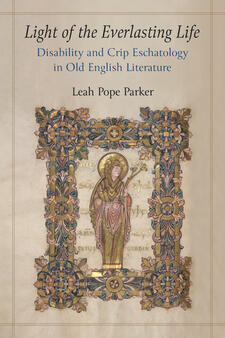
This guest author post is written by Leah Pope Parker, author of the new book Light of the Everlasting Life: Disability and Crip Eschatology in Old English Literature in the Corporealities: Discourses of Disability series from the University of Michigan Press. The book is available in hardcover, paperback, and open access.
In early medieval England, Christians envisioned the afterlife through disability and understood disability in the earthly life through the afterlife. This is what I argue in Light of the Everlasting Life: Disability and Crip Eschatology in Old English Literature. My analysis of Old English literature reveals some of the rhetorical, narrative, and theological frameworks organizing ideas about disability that helped those early medieval Christians think about their fears of damnation and hopes of salvation.
But studying disability histories can never just be about frameworks and fictions; it’s also about real people. That is why my chapters are organized around people who really existed—or who have been understood to have really existed—and their relationship to disability: King Alfred’s vision, St. Swithun’s crutches, St. Æthelthryth’s scar, St. Andrew’s blood, the poet Cynewulf’s wounds, and the body of Christ. When we study disability in the distant past, we must always remember the real people who experienced their bodies in the cultural frameworks we uncover, even though evidence for first-hand experiences of any early medieval bodies, disabled or temporarily able-bodied, is scarce. These medieval crip ancestors open up new ways of being in and thinking about our bodies, new ways of thinking about bodies that precede us, and new ways of thinking about history through the bodies that lived it.
Let me tell you about one.

Alfred the Great's statue at Winchester. CC-BY-SA Odejea
King Alfred the Great ruled first Wessex and later much of southern England from 871 to his death in 899 CE. He is called “Great” for his defense against the existential threat of Viking invasions, familiar in recent cultural memory thanks to The Last Kingdom, and his investment in education and the translation of Latin Christian texts into Old English, a defining moment for the cultural and religious legitimization of the English language. English literary history could not have played out the way it has without Alfred and the translation program associated with his reign. Indeed, it is hardly hyperbole to say that without Alfred, there might not be much of an England or any English literary history at all.
Alfred was also a real medieval person with a real medieval disability. The king’s chronic illness is well-documented by his biographer, a Welsh cleric named Asser that the king had recruited to his collection of scholars. A chronic gastrointestinal illness caused Alfred both pain and anxiety throughout his life. The way Alfred is reported relating to his own body through that illness is revealing of the impact a distinctly medieval spiritual understanding of disability could have on the day-to-day lives of early medieval Christians.
Asser’s Life of King Alfred tells the story of Alfred’s youth, how he became king, and his actions as king up to 893, when the Life seems to have been composed. After Alfred is already king, Asser pauses to say more about “the life, behaviour, equitable character and, without exaggeration, the accomplishments of my lord Alfred” (§73), as Simon Keynes and Michael Lapidge translate the Latin text. What follows is not a profile of Alfred’s royal personality and demeanor, but rather of the origins of Alfred’s illness. Asser tells us that at Alfred’s wedding celebration, the king was struck by “a sudden severe pain that was quite unknown to all physicians” which would go on for “many years without remission, from his twentieth year up to his fortieth and beyond” (§74). Asser then backtracks further to relate how Alfred had previously prayed for some other illness to replace the ficus—hemorrhoids—that he had suffered since his youth.
Asser tells us that Alfred stopped at a saint’s shrine while on a hunting trip shortly before his marriage. There the king “lay prostrate in silent prayer a long while in order to beseech the Lord’s mercy, so that Almighty God in his bountiful kindness might substitute for the pangs of the present and agonizing infirmity some less severe illness, on the understanding that the new illness would not be outwardly visible on his body, whereby he would be rendered useless and contemptible. For he feared leprosy or blindness, or some other such disease, which so quickly render men useless and contemptible by their onslaught” (§74). Asser reports that God granted Alfred’s prayer and replaced the ficus with chronic gastrointestinal pain, a progression that modern interpreters have aligned with what is now called Crohn’s disease (e.g., Craig, “Alfred the Great”). This pain was so intense that even when the illness abated, “his fear and horror of that accursed pain would never desert him, but rendered him virtually useless—as it seemed to him—for heavenly and worldly affairs” (§74).
Alfred’s view of impairment, as it is filtered through Asser, seems to have been somewhat nuanced and closely tied to the question of usefulness. He recognizes the special stigmas associated with leprosy and blindness—the latter of which is the subject of chapter 1, “King Alfred’s Vision,” in Light of the Everlasting Life—that could prevent those experiencing leprosy (or skin conditions perceived as leprosy) and vision impairment from useful participation in political and spiritual life. Alfred recognizes that a “less severe illness,” something “not […] outwardly visible,” could potentially fulfill the spiritually beneficial function of purgatorial suffering, to make the king more holy, without the stigma that would make him “useless and contemptible.” He prays to avoid stigma, yet in Alfred’s subsequent experience, the pain and anxiety—regardless of any stigma—challenge him nonetheless with a feeling of uselessness. Asser pointedly frames that uselessness as the king’s subjective point of view, for it was only “as it seemed to him,” that the king was not meeting the needs of his office.
Alfred certainly had a lot on his plate, enough to justify an exceptionally high concern about his “usefulness.” Shortly after returning to the historical narrative, Asser comments that the king, “amidst the wars and the numerous interruptions of this present life—not to mention the Viking attacks and his continual bodily infirmities—did not refrain from directing the government of the kingdom” (§76). What Asser calls the “savage attacks of some unknown disease” (§91) come up again and again alongside Alfred’s accomplishments in the defense of his kingdom and intellectual pursuits. Yet Asser never presents Alfred as overcoming his illness. Asser repeatedly caveats his own statements of Alfred’s accomplishments, for example saying that Alfred was eager to carry out his duties “in so far as his means and abilities—and of course his health—would allow” (§105). I am rather charmed by the notion that a king who would be called “the Great” had to manage his means, abilities, symptoms, and energy in order to fulfill his duties, with the result that he preserved what would eventually become a unified English nation from Viking invasion and solidified the foundations of a written tradition of English literature. As though living a medieval version of “spoon theory,” Alfred was able to accomplish what he did not in spite of his chronic illness, but because he learned from it how to balance his “means and abilities.” This king lived his life, with its exceptional burden of royal responsibility, in a way that resonates for many of us today who learn when we must hoard our spoons so that we may prioritize where we spend them.
It seems implausible to me that Alfred was so “Great” that he invented systems of caution and care out of thin air for his own needs. As much privilege as his proximity to and eventual wearing of the crown surely provided, systems of care and adaptation are shared by communities. So for all that Alfred is a classic object of the Great Man Theory of History, when we attend to his life in terms of a body that required rest and care, we can glimpse a more pervasive, more real sense of the lives lived around Alfred at every rank of society. One need not be a king to recognize, as Asser says Alfred did, that some impairments are more stigmatized than others, sometimes with spiritual consequences. One need not be a king to feel anxiety over the inevitable but unpredictable flare-up of a chronic illness. And one need not be a king to carry out one’s duties in both “heavenly and worldly affairs” as far as one’s means, abilities, and health will allow.
These are some of the ways disability could be experienced in Alfred’s time, and not just by Alfred himself. In Light of the Everlasting Life, I characterize an early medieval spiritual world in which real people lived, both Alfred and many more people whose names are not recorded in any surviving document, real people whose names were never even written down. Real people with real bodies with real hopes and real fears. Many of those hopes and fears extended beyond the earthly life and, as I show in Light of the Everlasting Life, this was a world in which disability was crucial to imagining, understanding, and hoping for the prospect of salvation in the medieval Christian afterlife.
Works Cited
Craig, Gillian. “Alfred the Great: A Diagnosis.” Journal of the Royal Society of Medicine 84, no. 5 (1991): 303–5.
Keynes, Simon, and Michael Lapidge, eds. and trans. “Asser’s Life of King Alfred.” In Alfred the Great: Asser’s Life of King Alfred and Other Contemporary Sources. Penguin Books, 1983.