Researching By Touch Alone
This guest author post is written by Vanessa Warne, author of the new book By Touch Alone: Blindness and Reading in Nineteenth-Century Culture from the University of Michigan Press. The book is available in hardcover, paperback, and open access.
Ten years ago, in the summer of 2015, I spent a week in London researching the history of street readers. Street readers were working-class blind people who read aloud from raised-print books on streets and bridges in nineteenth-century cities. I wanted to know more about their books, which were embossed in now obsolete tactile scripts named for their sighted creators, Thomas Lucas and James Hatley Frere. Rivals to braille, these scripts were just two of more than a dozen inkless script systems proposed for blind people’s use following the introduction of books for blind readers into Britain in the 1820s. I wanted to learn about these books so I could better understand their owners’ experiences of disability, literacy, and poverty. Highly visible members of the first generation of English-speaking people to learn to read by touch, street readers were the public face of a diverse community of visually disabled readers. Demonstrating a new mode of reading in city spaces, they provided many sighted people with their first opportunity to witness the reality of reading by touch. I hoped to find out how blind street readers felt about both their entry into literacy and their participation in a new form of street performance.
I searched for information about them at the British Library and at the Bloomsbury offices of the Royal National Institute for the Blind. I was able to view and touch books printed in Lucas and Frere script but I struggled to find statements made by street readers about their work. I did find reflections on this practice authored by observers, both blind and sighted. Unable to reimagine reading as an activity that did not require sight, some sighted commentators suggested that street readers were reciting from memory rather than reading by touch. Others went so far as to doubt the truth of street readers’ claims to be blind. Blind activists objected to this practice for different reasons. Some were troubled by the rapid transformation of blind people’s literacy into a commodified spectacle, like singing a ballad to solicit spare change. Reading for money, not for their own pleasure or edification, street readers revealed literacy’s failure to improve working-class blind people’s chances of employment. Edmund White, a railway worker who lost his job when he became blind, wrote about street readers in Blindness; A Discursive Poem in Five Cantos (1856). Desperate to earn money to support his family and deeply troubled by the poverty of many working-class blind people, he portrayed street readers as victims of “a sad disastrous fate” (5.252).
After a week of notetaking, I felt sure that street readers had a lot to teach us about both the history of disability and the history of literacy. I was eager to learn more about the ways reading shaped the lives of working-class blind people living in Victorian-era cities but I was also ready for a break. I had one day left in London and I wanted to spend it shopping, eating take-out sandwiches, and not thinking about the history of reading by touch. I was walking along Fulham Road, far from the library and archives, when I had an experience that not only pushed me back into research mode but also helped me better understand the history I had been exploring.
On the sidewalk outside a charity shop, there was a colourful fiberglass statue of a boy. The statue was chained to the entrance. Perched on a stool, neatly groomed and dressed in a bright yellow sweater, the boy held a book on his lap. With eyes closed, he touched the cover of the book with his fingertips. Below his feet, attached to the legs of the stool, a sign encouraged sighted people to “Please give to the blind.” The statue was designed so passersby could do exactly that. A modern-day version of a Victorian-era street reader’s tin cup, the book was hollow. A slot for coins was cut into the cover just above the boy’s fingertips.
I can’t remember whether or not I placed coins in the slot but I know I took photos of the statue with my phone. I thought about it for the rest of the day. I did not expect a random encounter with a charity store statue to help me understand the relevance of my research. Like the street readers of mid-nineteenth-century London, the boy’s reading was an affecting spectacle for sighted people’s consumption, one intended to prompt charitable giving. Street readers were a thing of the past but, as the statue’s present-day display signalled, the challenges street readers experienced as members of an underemployed, underestimated, and socially marginalized community persist in our own moment.
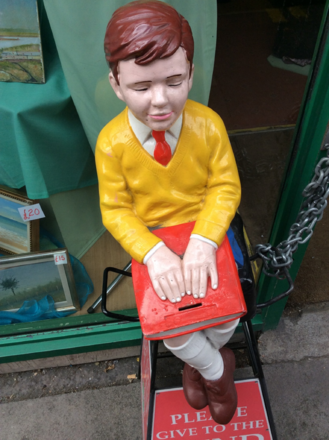
Statue belonging to the Greater London Fund for the Blind; Fulham Road, London (2015; author’s photograph). This photograph features a brightly coloured fiberglass statue displayed outside a charity store. The statue is chained to the doorway of the store. It depicts a neatly groomed boy dressed in colourful mid-twentieth-century clothing: a white shirt, red tie, blue shorts, yellow sweater, and white knee-high socks. A book with a bright red cover lies on the boy’s lap and his eyes are closed. There is a coin slot just above the child’s fingers, which are positioned as though he is reading by touch, this despite the fact that the book is closed. A sign in bold lettering beneath the boy’s feet reads “PLEASE GIVE TO THE BLIND.”
I was reminded by the statue that I also have ties to charities for blind people. Indeed, my work on the history of blindness and reading was prompted by time I spent volunteering in a charity with nineteenth-century roots. Searching for a volunteer job where my skills as a literary studies professor might prove useful, I joined a team of sighted readers working in a recording studio operated by the CNIB, formerly known as the Canadian National Institute for the Blind. I was reading aloud from textbooks and cookbooks selected by blind clients, but I knew very little about the history of blind people’s reading lives. Thinking back to that time, I realize that the themes my book examines in relation to Victorian culture were all around me in the twenty-first-century sound booth. They include innovative technology and its inevitable obsolescence, the role of charitable organizations in blind people’s reading lives, the enduring problem of limited resources, and the importance of blind readers’ preferences in regards to both what and how they read.
In addition to exploring the history of reading by touch, my book analyzes the material history of writing by touch, blind authors’ relationships with their amanuenses, and blind people’s experiences in museums and art galleries. Drawing on private letters, works of fiction, poetry, and journalism, it explores the nineteenth-century development of an inkless book culture created both for and by blind readers.
A lot has changed in the time it took me to write this book. The CNIB recording library where I volunteered has moved to a bigger city. The London offices of the RNIB also relocated. And, as I recently learned, the charity shop on Fulham Road has closed, which means that the fiberglass boy and his moneybox book are no longer displayed there. It is, however, changes to the accessibility of my sources that are foremost in my mind. I needed to travel to archives and libraries to study this history but, as a sighted scholar, the challenges of access largely ended there. I was able to read both ink-print sources and books printed in now obsolete tactile scripts by sight. The irony of needing sight to study the history of blindness was fully understood by the blind authors and activists whose work I was exploring. I regularly encountered statements by nineteenth-century blind people who were frustrated that the high cost of publishing raised-print books obliged them to publish their work in ink. One of them, Émile Javal, the author of The Blind Man’s World (or, in the original French, Entre Aveugles), was a medical doctor who became blind in midlife. Preparing his book for publication in 1903, Javal lamented that it could only be read by sighted people and not “the blind themselves” (3). Fortunately, within a year, a braille version of Javal’s book was published. And now, many decades later, it has, like many of my sources, been digitized, significantly increasing its accessibility for print-disabled researchers.
I feel fortunate to be sharing my work at a moment when digitization and screen-reading technologies have radically increased blind readers’ access both to historical sources and to scholarly studies like mine. I feel similarly fortunate to have received training in the creation of accessible written descriptions of visual culture, training I used to describe paintings, engravings, and photographs I discuss in my book. As blind readers continue to debate methods for accessing text, exploring, for example, the advantages of continued investment in the publication of braille books or of the prioritization of the development and proliferation of digital tools, I hope that the history of reading by touch shared in my book, a history that includes street readers, will prove useful.
Works Cited
Javal, Émile. The Blind Man’s World: An English Version of Entre Aveugles, trans. by W. Ernest Thomson, London, Pulman and Sons, 1904.
White, Edmund H. Blindness; A Discursive Poem in Five Cantos. London, James Martin, 1856