
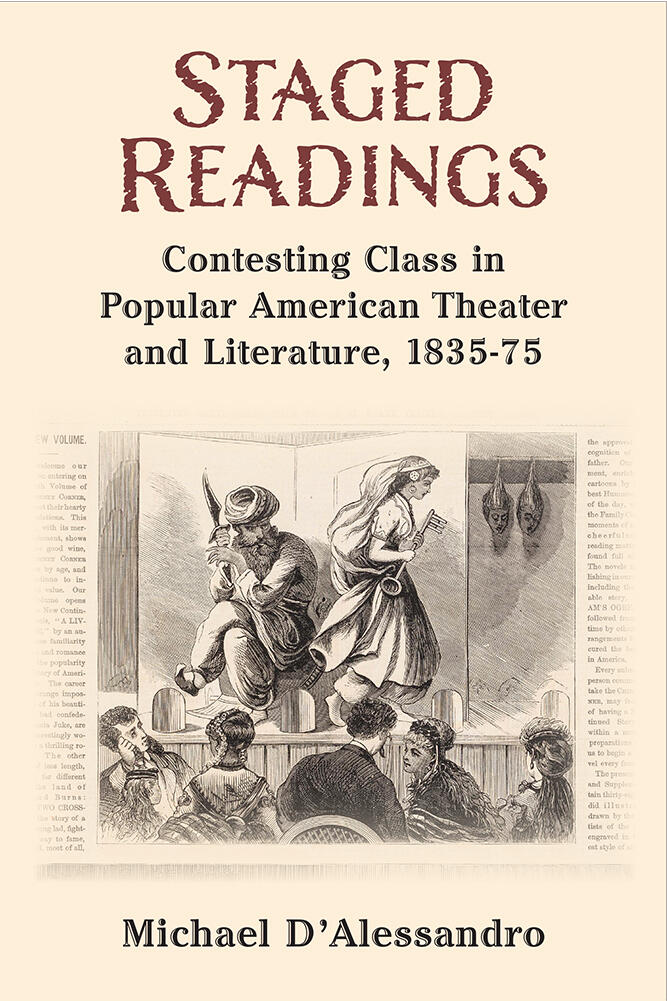
Staged Readings
Contesting Class in Popular American Theater and Literature, 1835-75
How popular culture helped to create class in nineteenth-century America
Description
Staged Readings studies the social consequences of 19th-century America’s two most prevalent leisure forms: theater and popular literature. In the midst of watershed historical developments—including numerous waves of immigration, two financial Panics, increasing wealth disparities, and the Civil War—American theater and literature were developing at unprecedented rates. Playhouses became crowded with new spectators, best-selling novels flew off the shelves, and, all the while, distinct social classes began to emerge. While the middle and upper classes were espousing conservative literary tastes and attending family matinees and operas, laborers were reading dime novels and watching downtown spectacle melodramas like Nymphs of the Red Sea and The Pirate’s Signal or, The Bridge of Death!!! As audiences traveled from the reading parlor to the playhouse (and back again), they accumulated a vital sense of social place in the new nation. In other words, culture made class in 19th-century America.
Based in the historical archive, Staged Readings presents a panoramic display of mid-century leisure and entertainment. It examines best-selling novels, such as Harriet Beecher Stowe’s Uncle Tom’s Cabin and George Lippard’s The Quaker City. But it also analyzes a series of sensational melodramas, parlor theatricals, doomsday speeches, tableaux vivant displays, curiosity museum exhibits, and fake volcano explosions. These oft-overlooked spectacles capitalized on consumers’ previous cultural encounters and directed their social identifications. The book will be particularly appealing to those interested in histories of popular theater, literature and reading, social class, and mass culture.
Michael D’Alessandro isAssistant Professor of English and Theater Studies at Duke University.
Reviews
An incisive, multimodal account of how Americans used their memories of entertainments . . . to establish the fragile social distinctions that undergirded the growth of American popular culture from the nineteenth century to today.
- Matthew Rebhorn
Significantly expands our knowledge of the ubiquitous, rich exchanges between theatrical stage and the printed page in the nineteenth century. . . . An important contribution to our understanding of the role of leisure activities and cultural consumption in constituting and maintaining class distinctions.
- Lori Merish
Presents detailed, well researched, and altogether valuable interpretations for scholars of 19th-century theatre and popular culture in the U. S. and contributes to an understanding of how middle-class Americans during the 19th century used literature and theatrical works to understand social positioning.
- Shirley Samuels
"Staged Readings is an exciting addition to nineteenth-century American theatrical and literary scholarship. Its focus on the importance of leisure culture in developing the class system today could expand to include other genres of American theatre and literature developing in the same time frame to expand this meaningful conversation. Theatre history, literature, and social science professors could incorporate any of the chapters from this book into early American studies or courses on how popular culture shapes society."
- Elaine Hendriks Smith, Theatre History Studies
"Staged Readings is a must-read for scholars of nineteenth-century American theatre culture and popular literature, and for those interested in melodrama and sensation literature more specifically. In every chapter, D’Alessandro leads the reader through a rich weave of historical context, archival materials, close analysis, and creative reflection; his method, that is, well suits his argument concerning narratives moving between literary and theatrical contexts. This lively book makes visible the emergence of class consciousness through public
- Laura L. Mielke, Modern Drama
performances defined not by a detachment from print but by an inextricability from it."
"[R]eaders are presented fascinating scenes from the archives—like, for example, the ingenious two-sided playbill for the Octoroon that enabled promoters to advertise the play’s engagement with slavery or deny it, depending upon the audience (135). Staged Readings is full of these entertaining, brilliantly positioned archival details. Plus, this learned book is very pleasurable to read."
- Mark Hodin, American Literary History