Q&A with Pain in Relation Author Alyson Patsavas
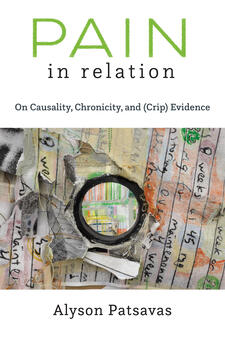
This guest author post is a Q&A with Alyson Patsavas, author of Pain in Relation: On Causality, Chronicity, and (Crip) Evidence. The book is now available in hardcover, paperback, and open access.
What inspired you to write Pain in Relation?
I would love to say that I wrote the book that I needed as a young person who was newly learning to live with chronic pain. I struggled to make sense of what my future would look like amidst the bewildering contradictory messages about chronic pain circulating within dominant US culture: the idea that chronic pain is both life-destroying and something we should just grin and bear, that it is both uniquely subjective and standardizeable on a 1-10 scale. It took finding a critical disability analytic, alongside a grounding in feminist and queer cultural analysis, to gain the tools to see the harm embedded in these messages. These tools were nothing short of life giving and I wanted to write a book that could capture, model, and amplify the perspective shift that these tools offer, to bring the lens that helped me to “expose” and then “remake” these harms to a broader audience.
That said, this version of the book’s origin story suffers from a bit of hindsight. So much of writing and thinking is intertwined, and I think it’s probably more accurate to say that I wrote Pain in Relation with a far fuzzier intent, at least from the start. In many ways, the book’s inspiration started as more of an archival project. It aims to document an ongoing effort to make sense of how disability, gender, race, power, privilege, personal experience, and knowledge come together to shape US cultural understandings of pain in order to intervene in them. The insights that disabled, pained, and chronically ill folks have gained learning to navigate pained life within a culture that devalues and dismisses our experiences is hard won and something that continues to feel urgent to record and share.
If a book club was to select your book, what are 3-5 questions you might recommend to start the discussion?
I would start first by asking readers to reflect on their own relationship to the cultural discourses of pain that Pain in Relation traces. This book is meant to be an invitation, and I think that personal experience is the best starting place for dialogue with the project. With that, I’d ask readers to consider: Which of the narratives traced within the book most shape their own pain experiences? How does the project’s analytical lens help you (re)consider your relationship to those narratives?
I would then invite readers to take up one or more of the experiments that the second half of the project outlines. Part 2 of the book, “Remaking,” delves deeper into the autotheoretical components of the book, and autotheory—or turning to the personal as source material for theorizing—raises productive questions about scale and context. With that in mind, I would ask readers to consider how the evidencing practices, vocabulary building exercises, and list-making that I take up in the book resonate with them. Where do their own experiences grate up against the details of pained life that the book traces? What aspects of the analysis, in its move from my own experience to larger theoretical claims and structural analysis, would be extended, complicated, or remade by those experiences?
Did you encounter any particular joys or challenges when writing the book?
The joys and challenges of writing Pain in Relation are deeply intertwined for me. Working with and from such personal material is difficult. For me, it required a level of unflinching vulnerability that made an already challenging task harder. I talk in the book about getting sicker and more disabled during the writing process. This created real material challenges as I struggled with growing fatigue, worsening pain, and a range of new symptoms that required learning new ways of being and working. Without burying these struggles under a pile of glitter, this prompted me to experiment with methods in ways that I found unexpected joy in. I had fun channeling my frustrations with yet another round of specialist visits into the often-snarky annotated list of recommendations “for pain” that readers will find in Chapter 6 of the book. I loved making the pain selfie scale that I talk about in Chapter 4 and found joy in the creative process of vocabulary-building from journal entries that I detail in the book’s 5th Chapter. I also loved immersing myself in other pained people’s work. I found balms in the ways that other writers, artists, and thinkers reshape their relation to pained life.
Alongside this joy, being so immersed in pain while living through an intense period of pain flares infused the writing process with a heaviness. I do not want to skirt around that. Living, researching, reading, and writing about pain was often overwhelming and painful in its own way. It would be disingenuous to write a book that argues for more conversations about pain without accounting for how hard it is to fully immerse ourselves in the hardest parts of our own and our community members’ experiences.
Congratulations on publishing your first book! Now that you have been through the process, do you have any advice for others working on their first book?
Recognize from the very start that book writing is a community-fueled project. Some of the best advice I received from friends and mentors was about seeking feedback on early drafts, not holding the project too close, and approaching feedback as a gift of labor and care. This helped me approach each draft and stage of the book-writing process as its own goalpost. For early drafts, I focused on producing a detailed and clear enough draft to get the most out of my reader’s feedback rather than on producing a finished product before seeking feedback.
Book writing also requires many different types of readers, readers we trust with the messy drafts, those who will be our cheerleaders, and those who won’t spare our feelings and bring a heavy-handed red pen to each page of the manuscript. We need readers who can get us to the next stage of the writing process and those who help polish our work for publication. These are rarely the same people. I relied on a network of people who shaped, pushed, and sharpened my thinking and writing. This included friends and mentors as well as more formalized supports like working with a developmental editor (shout out to Dr. Therí Pickens). So, my biggest advice is to use all the resources and use them early and at each stage of the process. Dispel any fantasy that a monograph means working alone.
What do you hope readers will take away from reading Pain in Relation?
I hope that readers take away a sense of uncertainty and curiosity from reading Pain in Relation. I want them to close the book feeling less certain about what they know about chronic pain experiences than when they started because, if they do, that means I will have convinced them of the constructed, limited, and limiting nature of dominant US cultural narratives of pain. This, I hope, comes with an equal curiosity and openness to learn from and about how people in chronic pain craft complex and contextually specific lives over and against these narratives.
There are, of course, more specific arguments that the book makes that I hope readers will pick up and take away from the book: the argument that disability discourses sit at the center of US cultural understandings of pain; that race, gender, and disability work together to differentially shape whose lives are presumed to be painful, whose presumed to be pain-free, and how that shapes how society responds to people’s pain; feminist, queer, crip, and chronically-ill methods offer unique evidencing practices that can reshape how we produce knowledge about pain; that there are many ways to relate to pain and pained life and we need all of them to craft more livable worlds for people living with and making sense of pain.