Femme UrbAfricana
Tracing Fela’s African “Lady” across Black City Networks
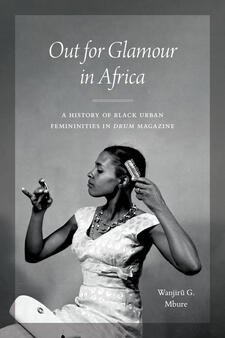
This guest author post is by Wanjiru G. Mbure, author of Out for Glamour in Africa: A History of Black Urban Femininities in Drum Magazine. The book is available in hardcover, paperback, and open access. Visit Spotify for a playlist to accompany the book.
In the highly acclaimed podcast, Fela Kuti: Fear No Man, host Jad Abumrad delves into the lives of the women behind the Afrobeat king in "Queens," the sixth episode of the series.
The episode ends with the artist’s 1972 song "Lady" from the album Shakara.
“If you call am woman
African woman no go agree
She go say…….
She go say I be lady o
She go say I be no woman o
She go say I be lady o
She go say market woman na woman
She go say I be lady o”
In a short clip of Fela’s performance of the 13-minute song, the "Queens" are in the background with short afros, glossy lips, and large hoop earrings as Fela mimics the supposed poise and posture of a “Lady” while singing, "I wanna tell you about Lady."
In a discussion that echoes scholars Cynthia Enloe's and Gayatri Spivak’s questions, “Where are the women?” and “Can the subaltern speak?" the podcast episode marks an extraordinary moment when listeners hear from the women themselves. What is striking about hearing the women discuss their time with Fela is the sense of urban precarity in 1960s Nigeria as young females and the limited opportunities they had for advancement. There is also a sense of agency and power that the “Queens” describe in making difficult choices about survival and success in the city.
Afrobeat queens and Fela’s “Lady” belong to a generation of women across the African diaspora who, in the 1950s, 1960s, and 1970s, are navigating urban life and making the most out of the opportunities available to them. Across the African diaspora, these women’s efforts and the media and artistic forms that embrace them materialize an Afro-descended woman-as-city trope: vibrant, young, energetic, unstable, emerging, and precarious. I term this novel model of Black femininity femme urbAfricana. The arrival of Fela and Africa ’70’s "Lady" in 1972 coincides with its maturation.
In 1958, as Fela was likely in London studying music, Drum magazine, which originated in South Africa in 1951, informed its extensive continental readership that Helen Anyameluna, Nigeria’s second beauty queen, was en route to Paris for a 10-day visit. The magazine featured Helen, who smiled and wore her Miss Nigeria sash, walking to “the aircraft that’s going to take her to the great wondrous city of her dreams.” Helen's and Fela’s journeys to Paris and London, respectively, were not atypical of the colonial era. What is remarkable is how little is known about how Black women found urban success during this time period.
The previous year, in 1957, Nigeria’s first beauty queen, Grace Oyelude, had traveled to London. During her visit, Grace "seized the opportunity" to follow up on a nursing school application, managing to secure her “admission and everything” on her day off. She returned to Nigeria after her beauty queen tour but commenced her training as a nurse in London a few months later. Upon completing her training, Grace returned to contribute to the post-independence nation-building project. Grace’s story of professional success is intricately tied to a period in African urban history when glamour through beauty pageants dominated African print media and offered some women a ticket to success. As a magazine intent on capturing the urban life of Anglophone Africa, Drum also highlighted Fela’s artistic accomplishments besides those of other African musicians.
Alongside women like Helen and Grace, femme urbAfricana also encompassed first-generation African film stars, advertising models, professional pioneers, and politicians.
Out for Glamour in Africa: A History of Black Urban Femininities in Drum Magazine underscores the active role of these urban Black women as they sought to enhance their opportunities for advancement. Using archival research on advertising, film, government records, and close analysis of Drum magazine’s various editions (South Africa, West Africa, and East Africa) and its print contemporaries, the book traces the emergence of femme urbAfricana. The generation of women featured in Drum magazine was imagined as an emblem of urban success in cities such as London, Harlem, Nairobi, Lagos, Accra, and Paris. Some, such as Juby Mayet, wrote about city life in the magazine. Notable artists like Miriam Makeba and Dorothy Masuka, who, like Fela, used their voices to speak truth to power, were also part of this generation. In this 2014 clip, Dorothy describes their close friendship as well as the struggles faced by other singers from this era and discussed in the book, including Dolly Rathebe and Thandi Klaasen.
Understanding the contributions of these women, as told through the pages of Drum magazine, requires looking beyond the tangible accomplishments of Black women in urban milieus to consider how bodies, specifically Black female bodies, were and are negotiated, displayed, and imagined in towns, nation-states, regions, and the diaspora. As Out for Glamour in Africa: A History of Black Urban Femininities in Drum Magazine argues these questions are not only about amplifying women’s voices but also about expanding the current understanding of Black urban femininities and the forces that shape them.
References
Enloe, Cynthia. Bananas, Beaches and Bases: Making Feminist Sense of International Politics. Berkeley: University of California Press, 1989.
Fela Radio Shrine. 2019. "LADY - FELA ANIKULAPO KUTI & AFRICA 70." YouTube video, 13:48. May 16. https://www.youtube.com/watch?v=_1xNHUTzBUk.
“Fela’s Fabulous Highlife," Drum, February 1966.
Higher Ground. 2025. Fela Kuti: Fear No Man. Podcast series. Hosted by Jad Abumrad. Apple Podcasts. https://podcasts.apple.com/us/podcast/fela-kuti-fear-no-man/id1835735529
“How does it feel to be Miss Nigeria?” Drum, October 1958.
"I Became First Miss Nigeria by Accident - Chief Grace Oyelude [Interview]." 2014. February 22. AllAfrica.com. https://www.proquest.com/wire-feeds/i-became-first-miss-nigeria- accident-chief-grace/docview/1501466615/se-2.
Mail & Guardian. 2014. “Tea with Dorothy Masuka.” YouTube video. July 4, 2014. https://youtu.be/vxPB1nKBJ2U.
Mayet, Juby, and Union of Black Journalists (South Africa). 2022. Freedom Writer: My Life and Times. Johannesburg: Jacana Media.
“Speak Up, Man,” Drum, September 1958 (East Africa October 1958)
Spivak, Gayatri Chakravorty. 1988. “Can the Subaltern Speak?” In Marxism and the Interpretation of Culture, edited by Cary Nelson and Lawrence Grossberg, 271-313. Urbana: University of Illinois Press.