Q&A with Lavender Sounds Author Stacey Copeland
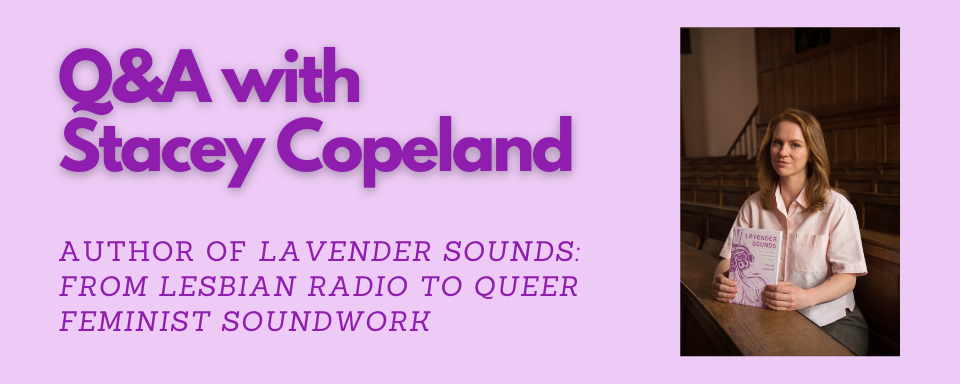
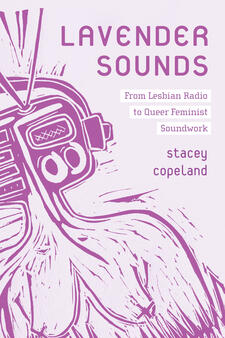
This guest author post is a Q&A with Stacey Copeland, author of Lavender Sounds: From Lesbian Radio to Queer Feminist Soundwork. The book is now available in hardcover, paperback, and open access.
What inspired you to write Lavender Sounds?
The project is very much inspired by my academic and personal love for sound and queer culture. Early in my graduate work I was poking around the Archive of Lesbian Oral Testimony online, housed at Simon Fraser University, for an entirely different project when I stumbled onto recordings of The Lesbian Show from Vancouver Co-op Radio. I sat in my little apartment listening to a person named Cathy reflect on knowing she was a lesbian before she knew any other lesbians existed — the radio was her connection. Decades separated us, but their voice resonated in my body. That uncanny closeness, a relationship with voices from the past, is what pulled me into Lavender Sounds and never let go.
The other inspiration was frustration. Lesbian and feminist cinema, literature, and music all have rich fields of scholarship devoted to them, but soundwork — radio and podcasting — is often treated as a "secondary medium," background noise you half-listen to while you cook or drive. I wanted to argue that these everyday sounds are doing important political and community work precisely because of their everydayness, and that they deserve to be listened to closely and critically alongside other media forms.
Since your book explores how communities connect over radio and podcasting, do you have a favorite podcast to listen to?
Asking a sound scholar to pick one is a bit cruel, so I'll start with three at the top of my listening list. The Heart has a permanent place in my listening life, and I write about it at length in Lavender Sounds. It's become a go-to example of podcasting's "intimacy" across podcast studies, but I think that framing sells it short. What The Heart actually does, when you listen closely, is put Audre Lorde's concept of erotic power to work in sound — connection, self-connection, and the capacity to feel joy outside heteronormative scripts. It's queer feminist aesthetics as production practice, not just as subject matter but in the team's deeply personal and playful approach to the craft of soundwork.
A mainstay in my podcast feed is The Kitchen Sisters, who have been making some of the most beautiful documentary work in the medium for decades. Their episode "Quilts as Monuments: Sew Their Names," which landed on the feed in June, is what I listened to this morning in bed with my coffee. Their audio documentary “WHER: 1000 Beautiful Watts” is one I go back to often, for inspiration, chronicling the story of the first all-girl radio station in the United States, based in Memphis, Tennessee.
Finally, The Log Books from Aunt Nell Productions, which re-voices the call log books of the UK's Switchboard LGBT+ helpline. Hosts and producers Tash Walker and Adam Zmith speak to LGBTQ+ elders and peers about life in Britain, inspired by volunteers’ logs since 1974. I'm a big fan of a lot of Aunt Nell's ongoing work, precisely because it blends queer archival practice with the power of sound and voice.
If a book club was to select your book, what are 3-5 questions you might recommend to start the discussion?
I love the image of a book club debating over the sounds of campy lesbian radio:
- The book asks you to become an "earwitness." What's a sound, song, or voice that instantly returns you to a particular community or moment in your own life — and what makes sound do that so powerfully?
- I distinguish audibility activism from the more familiar politics of visibility. What can we hear about a person or community that we can't see, and what gets lost when queer culture is measured mostly by who's visible?
- Camp, play, and eroticism run through these soundworks, from a lesbian sci-fi radio parody to a punk reading of Xena. Why might playfulness and pleasure be political tools rather than distractions from "serious" activism?
- The book insists that "lesbian feminism is everywhere," even when it goes by other names. Where do you hear its echoes today — in podcasts, protests, music, or online?
- Much of this history was nearly lost, surviving only as fragments in under-funded archives. Whose stories in your own community are at risk of disappearing, and who's responsible for keeping them?
Did you encounter any particular joys or challenges when writing the book?
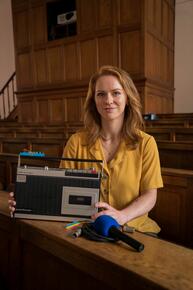
Photos of Stacey Copeland by Vanesa Miteva
The central challenge was scarcity. Queer feminist radio histories are ephemeral — recordings get taped over, collectives disband, and what survives is fragmentary. I leaned on what Jack Halberstam calls a "scavenger methodology," stitching together archival recordings, newspaper clippings, and semi-structured interviews with former hosts of The Lesbian Show and its Montreal counterpart Dykes on Mykes. I had to make peace with the idea that there can be abundance in scarcity, that the gaps themselves tell you something.
The joy was the listening and the people. Listening to and exploring these soundworks, then getting to talk with the very soundworkers who made them is always a gift. I also kept audio diaries throughout — unfiltered creative play that became the basis for the story-driven openings of each chapter and for the book's audio companion, Lavender Sounds: The Audio Archives. Being able to write a book about sound that you can actually hear alongside the text is a deeply challenging but satisfying process.
Congratulations on publishing your first book! Now that you have been through the process, do you have any advice for others working on their first book?
A few things. First, let the form of your book match its argument. Because mine is about sound, it had to make sound audible — hence the open-access audio companion. I wanted to work with the University of Michigan Press for this reason. They gave me the platform and space to craft a project beyond the page.
Second, build community as you go throughout each step. This book genuinely isn't only mine; it belongs to the hosts and producers who trusted me with their stories. Those relationships make the work richer and kept me grounded in what matters to both media makers and researchers right now.
Third, embrace the mess. Fragmentary archives, dead ends, and "glitchy" gaps aren't failures of research — they're often where the most interesting questions live. And practically: keep some kind of reflective diary through the process. Mine started as a coping mechanism and ended up shaping the whole architecture of the book.
Finally, consider open access if you can. I wanted the communities I write about to be able to read and hear this work without hitting a paywall, and I'm grateful the press made that possible.
What do you hope readers will take away from reading Lavender Sounds?
Two things, really. First, that soundwork has been — and still is — essential to how queer and feminist communities share information, build kinship, and advocate for one another. Radio and podcasting aren't just entertainment happening in the background; they are infrastructure for survival and connection.
Second, that the sounds of queer feminism are everywhere if you listen with a tuned ear. This isn't a nostalgic book about a movement that's over. Lesbian feminism didn't disappear — it diffused, took new names and forms, and it's thriving in podcasts, protest chants, music, and TikTok alike. I end the book at a Dyke March, hearing the same energy in the crowd that I heard in the radio archive. My hope is that readers finish the book and can't stop hearing it: that they leave with what I think of as a call to ears, ready to listen for these voices, amplify them, and maybe even pick up the microphone themselves.