How to Write About a Robbery
This guest author post is by Isabel K. Köster, author of Stealing from the Gods: Temple Robbery in the Roman Imagination. The book is now available in hardcover and open access.
At 9:30 a.m. on October 19, 2025, thieves rolled up to the Louvre in Paris with a furniture elevator and used it to gain access to the upper story. After cutting through a window using power tools, they entered the museum and forced some guards to flee. A few minutes later, they left on motor scooters with eight priceless pieces of the so-called French crown jewels. While some suspects from the break-in were identified quickly, the people behind the crime and the fate of the jewelry remain unknown. The objects are too easily recognizable to be sold as is, hence experts fear that they have been taken apart and melted down for their material. Grief at the loss of priceless pieces of French heritage was swift. Equally swift was outrage at the museum’s security arrangements: the jewels had not even been protected by cameras.
My book, Stealing from the Gods: Temple Robbery in the Roman Imagination, deals with some of the ancient equivalents of the 2025 Louvre theft. With their thick walls, imposing doors, and—occasionally—armed guards and guard dogs, sanctuaries in the Roman world often functioned as repositories of treasure. Major sacred sites, such as the Sanctuary of Apollo at Delphi or the Athenian Acropolis, were entrusted with deeply significant and precious objects. For thieves, bandits, and attacking armies, temples were tempting targets. While temple robberies were inevitable, they were unacceptable attacks on the gods and their property.
Writers from the Roman period have left us with several accounts of spectacular thefts from sanctuaries. These narratives offer parallels and differences with reporting on the Louvre incident and give us an insight into how Romans might have reacted to the loss of a community’s treasures:
First, robbers look at the world differently. The horror that someone could treat the French crown jewels as mere heaps of precious metals and gemstones finds ready parallels in the Roman world. Temple robbers also have a unique way of perceiving valuable objects. Where others see a statue of a god that a community has worshipped for centuries, the robber sees a pile of shining bronze. Accordingly, ancient temple robbers pull down statues and break objects because only the material value matters to them.
Temple robbers also have a unique way of interacting with their environment. Like the Louvre robbers, ancient temple robbers move around spaces in unintended ways. They break doors, gain access to areas where they are not supposed to be, and attack guards (unlike the Louvre robbers, however, they tend to operate under the cover of night). Details about how robbers disrespect architecture and bypass security arrangements both satisfy curiosity about how the incident could have happened and serve to present the robbers as transgressive visitors to the site. It should be shocking to a non-criminal audience that anyone would behave in such a way.
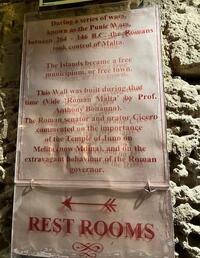
Sign in a restaurant in Mdina, Malta, recalling Gaius Verres. Photo by Ingrid Köster.
Modern news reporting and Roman writers differ on why they tell their audience about a spectacular theft. Contemporary accounts strive to provide an accurate picture of current happenings with the latest information. Ancient authors, on the other hand, are interested in telling stories about bad people. A major villain in my book is Gaius Verres, who was the Roman governor of Sicily from 73 to 71 BCE. Following his term in office, the orator Cicero prosecuted him for extortion and embezzlement. As is conventional in a Roman trial, the prosecution takes a maximalist approach: Cicero does not just provide evidence of financial misdeeds, but shows Verres as a thoroughly rotten individual. Attacks on sacred spaces illustrate the governor’s insatiable greed and lack of respect for social and religious standards. The defendant, so Cicero tells us, relied on his official office to protect him and was open about his crimes. Even if the governor was not present at the scene and sent thugs to obtain the objects of his desires, everyone immediately knew who was behind the attack. Only Verres, after all, would even conceive of stealing a famous bronze statue from a Sicilian sanctuary, votive offerings from a Maltese temple (see photo), or gold from the Acropolis. Since this was not a prosecution for corruption, not temple robbery, Cicero did not have to worry about proof. He merely had to show that it was plausible that Verres was indeed that greedy. Modern reports often do not have readily identifiable villains. In fact, it seems unlikely that the person or people behind the Louvre theft will be identified soon. Their motivations also remain unknown.
Ancient narratives and modern reactions to major thefts also differ in their perception of responsibility. Most reporting on the Louvre break-in attributes a share of the blame to the museum. The number of memes mocking the insufficient security arrangements keeps growing. Because Roman narratives of temple robbery aim to expose depraved individuals, they rarely blame sites for having objects stolen. While sanctuaries took precautions against thieves, the literary accounts present us with attackers who are so violent and unconcerned with consequences that it is almost impossible to resist them. Hence, those who steal famous objects from famous sanctuaries are in a different category of villainy. Regular humans (and often even the gods) are powerless against them.
Due to differences in genre and narrative function, Roman writers and modern news reporters look to different things when reporting on a major theft. Nowadays, we want to know what was stolen and what could have been done to prevent the crime. We are quite used to waiting a long time before we find out who was behind the theft. The Romans, on the other hand, are interested in presenting villains who have done irreparable harm to a community. What was stolen is important, but not nearly as important as by whom.