Q&A with Dan DiPiero
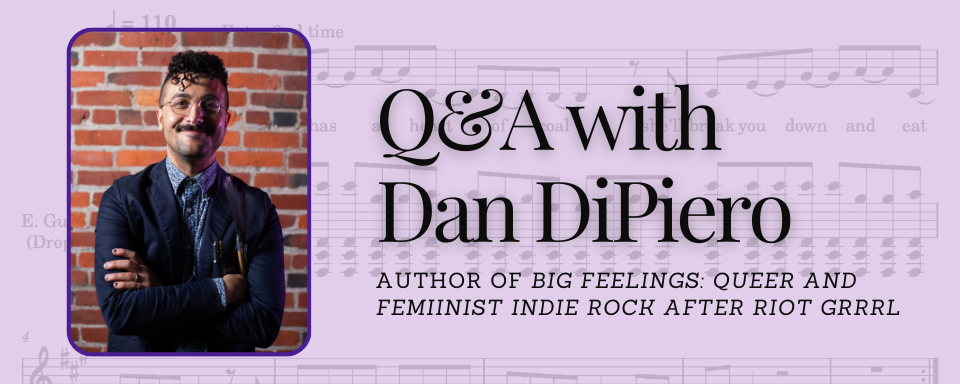
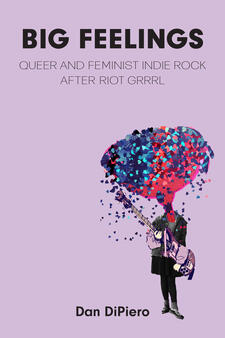
Dan DiPiero is Assistant Professor of Music at Boston University. In this Q&A, we talked about his new book Big Feelings: Queer and Feminist Indie Rock After Riot Grrrl, which is now available in hardcover, paperback, and ebook.
Q: In your introduction you start off talking about how certain songs are tied in with your memories—hearing Smashing Pumpkins’ “1979” at a friend’s house or hearing the song “Rubber” on a first date. Why do you think some songs stick with us?
A: I think songs stick with us when there’s a strong attachment between feeling and circumstance. If music is a part of making that situation feel the way that it does, then all the more so. But in order for it to do that, I think the music has to already resonate with something in our lives, has to have an easy way into one’s affections, even if you’re not quite sure about what that’s all about. When I first heard the Pumpkins, I was nine years-old, way too young to understand anything about myself or the musical tastes I was developing in real time; nevertheless, “1979” spoke to me in part because I was already coming up in a cultural milieu where alt rock was very well understood as just about the coolest music out there, especially if you were a young white boy. In retrospect, I do think that there’s something about who I was learning to be at that age that already identified with what I today understand as the nostalgia that “1979” invokes, the wistfulness and emotional complexity that was articulated in the language of a genre I was already familiar with, but which stood out as an exception within that space. It was interesting, in other words, and I was making formative memories when I heard it.
Q: I love that you put together a Spotify playlist to accompany the book because it helped me get a feel for the music you are talking about. Is there a particular song that is a favorite for you?
A: It’s impossible to pick a favorite with such a huge playlist spanning so many decades. But these days, “Ohio All The Time,” is certainly on heavy rotation around our house. I’m thinking of getting a tattoo about it. Readers will understand ;)
Q: Could you tell us a little bit about the young queer and feminist indie bands that you think are re-making rock music right now? What makes them similar or different from previous musicians?
A: In one of the blurbs for Big Feelings, Alyx Vesey calls this music an “intergenerational exchange,” and I think that’s a nice way of framing the ways in which bands like Soccer Mommy and The Ophelias are deeply referential, deeply historical—that is, they’re drawing on and synthesizing a really diverse array of popular music from the past even as they use those influences to break new ground. As I point out in the book, this is really the first generation of rock artists who has come of age during the poptimist consensus, which made it not only cool but almost mandatory to appreciate all kinds of genres, including pop music that was not taken seriously when I was younger. That’s one big difference: at the same time that these young musicians are deconstructing the male-dominated rock music of the past, they’re also creating new, more diverse, more feminist and queer canons of their own, expanding what counts as important and to whom. They’re pointing to music that matters to them from both the past and the present, making links that Sara Ahmed calls “citational chains” to draw together an intimate public of like-feeling fans. It’s not about homogeneity; it’s about community.
Q: In the book, you include snippets from interviews with other listeners. How did talking to others about their experiences add to your understanding of the music you discuss?
A: It added a tremendous amount of nuance to how I was framing the socio-historical context of this music’s emergence. When I argued that part of the reason this music means what it does to young people is because of how difficult their lives are, I was offering what amounted to an hypothesis—but I couldn’t speak for them, for these listeners who are fifteen or so years younger than I am, who were having experiences that resonated with my own life, but which were very distinct at the same time. To have my interview respondents affirm my suspicions in their own words—and then to expand what I was thinking about into new areas—remains an irreplicable and very treasured aspect of this book for me. They put ideas together in ways I never could have, because those ideas come from how they’re living, how they’ve been living through their teens and early twenties. I’m very grateful to them.
Q: What inspired you to write Big Feelings? Did you encounter any particular joys or challenges in the writing process?
A: While I was writing my first book, I had spent more than a decade immersed in jazz and improvised music. Turning attention to Big Feelings was like a homecoming for me, back to the kind of rock music that first shaped my listening habits and musical tastes. I got excited when I started hearing the sounds of my childhood coming back around again in a new generation of artists. But I realized immediately that of course the music wasn’t the same as when I was a kid; it was actually way, way more compelling to me, to the version of me that I was after grad school, in my early thirties. I was so hooked on what these bands were doing, and nobody was writing about them. It was more a compulsion than anything. I couldn’t stop thinking about the music. The entire project has been a joy to write, and I’m extremely lucky to have incredible people in my corner helping along the way.