Q&A with Author J. Rey Lee
Author of Unsettling Catan: Detached Design in Eurogames
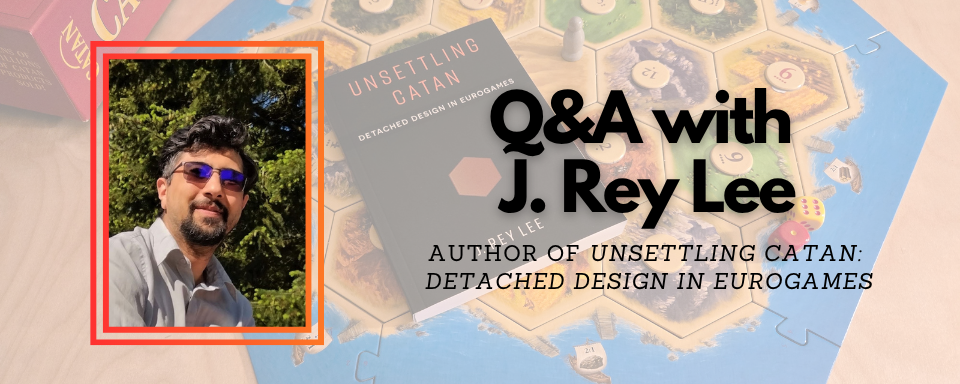
This guest author post is a Q&A with J. Rey Lee, author of Unsettling Catan: Detached Design in Eurogames. The book is now available in paperback and open access.
Q: Your book is the first to be published in our Tabletop Games series. What was it like to write a book that you knew would be kicking off a new series?
I immediately fell in love with the vision for the series, so I was thrilled to be invited to get the ball rolling. I love that this series is trying to carve out a new space for talking about tabletop games that can bridge the gap between game scholarship and the boardgaming community.
But there’s always going to be some uncertainty when starting something new. In the early stages of the project, my challenge was to find an appropriate scope for the project. As much as I loved the overall vision for the series, it was quite challenging to get a clear picture of what that might look like in practice. I kept pestering the editors with new ideas and drafts because I never felt at ease about whether what I was doing would fit. I honestly didn’t breathe easy until after I’d received a go-ahead on the first draft of the completed book.
In the later stages of the project, my challenge was to pitch the book to an audience that is largely hypothetical. Every single aspect of this project is a leap of faith. We believe the readers are out there, but we don’t have any direct experience of who might pick up a book like this or how they will react if they do. To address this, I set up some “playtesting” sessions to see how non-academic readers might react to the book. I got some good insights from this, but it also made me appreciate how difficult it can be to organize an effective playtesting session. And I still have no idea how representative the playtesting ended up being.
Despite all this, I really loved working on this project. I loved the creative freedom that came with not having to fit a clearly defined mold. I loved how this project led me to have all kinds of interesting conversations I wouldn’t have had otherwise. I even loved how this project made me question how and why I write. It helped me realize that I don’t really want to live in a purely academic space, which inspired me to launch a boardgaming blog immediately after submitting the final manuscript. To me, it’s always a good sign when I close a project abuzz with ideas for what comes next.
Q: What is your favorite board game? And why?
There was a time in my life when I would have said Catan and a time when I would have said Pandemic, but right now I’d probably go with Revive from Aporta Games. It’s quite a bit more complex than Catan, but I love how it puts a new spin on some of the same core sentiments.
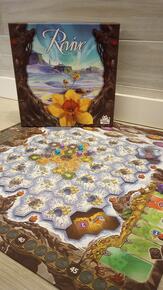
On the surface, both games look pretty similar with players placing colored buildings on hexagonal terrain. But Revive feels less colonial because it has this intriguing narrative frame where humans are emerging from a literal hole in the ground to repopulate land they once destroyed. It also feels much less territorial because my “little empire” crisscrosses with my rivals’ empires in a more organic way. Instead of one player completely cutting off another, there’s more leapfrogging as players reveal new areas that create new building spots for everyone, so it feels more like we’re all part of the same expanding ecosystem.
I also love that Revive has extremely impactful and varied goals that change from game to game. Some folks complain that these aren’t quite balanced, but I really appreciate how they make me change my playstyle and find cool combos. Overall, Revive just feels so much more abundant than Catan. It always feels like I have tons of good options to choose from and can find a way to pivot when my plans are foiled. So fun!
Q: What can studying board games tell us about society?
What can’t it tell us? All good art has a way of reflecting surprising dimensions of our cultures and ourselves. Boardgames can touch on any aspect of society the way novels, films, and any other form of art can. So, the question is less what can boardgames teach us and more how they can teach us.
Before getting into boardgames more specifically, I want to make a plug for studying culture through play. I truly believe that play is egregiously understudied as media or art. Sure, there’s plenty of good research on play in psychology, anthropology, and other social sciences. But when we study media, we often privilege narrative media over play media. And, as much as I love talking about stories, this paints a very one-dimensional picture of culture.
It's not just that people play a lot. It’s that play offers a different way of engaging in culture than traditional narrative media. Think about the theme of war. A novel, a film, and a game can all have anti-war messaging, but they feel completely different. Maybe a wargame isn’t as likely to tug on the heartstrings as Life is Beautiful or provide as incisive satire as Catch-22, but games also do things that films and novels can’t match. Games allow players to co-create their artistic experience and create meanings for themselves. Games teach us about culture by letting us play out cultural dynamics.
I think the bias towards narrative media comes from an outdated assumption that good art is all about the self-expression of a genius artist. We don’t typically think of games this way. But what if good art is all about the experience of the reader? When we adopt a more audience-centered view of art, play becomes more significant—doubly so when we consider the rise of participatory media culture, an audience-centered dynamic where fans actively drive the media ecosystem.
We need more study of all forms of play, but I personally gravitate towards material forms of play like toys (my first book was on LEGO) and boardgames. I find it fascinating how boardgames blend tactile experiences and abstract systems, creating profoundly holistic play experiences that complicate pernicious binaries like mind vs. body or analog vs. digital.
That’s why I dedicate an entire chapter of the book towards helping develop a media theory for boardgames that accounts for the unique way boardgames make meaning. I talk about how boardgames see the world through the glimpse and glance instead of the more traditional filmic gaze and how they create resonances and dissonances instead of offering traditional messages or morals.
Q: Many people would consider Catan an example of a classic board game. Why does your book focus on this game specifically?
Catan is absolutely a modern classic well-deserving of being the first game featured in this series. But being a classic isn’t enough to make me want to write about it. As I described in my first design diary, I was initially wary about writing about Catan because writing on the classics sometimes creates very dry and dusty historical analyses. Instead, I really wanted this book to speak to our current moment in gaming. Fortunately, it turns out that Catan reveals quite a bit about our current moment.
The most important connection is how Catan’s desire to produce peaceful feelings led to innovations in what I’m calling detached design. For Catan, this was all about trying to make a game about settlement feel less colonial. For other eurogames, this can include avoiding all kinds of problematic historical entanglements. And while I get why games would want to avoid controversy, I want to question what happens when games avoid controversy by attempting to detach from any complicated feelings. It’s odd to see an art form essentially repressing its own artistry, but eurogames have made a whole style out of it. That’s why contemporary eurogames have such a reputation for being drab and unthematic.
I especially like using Catan to unsettle detached design because Catan’s early innovations undermine some of the patterns that later eurogames have settled into. Catan can simultaneously shed light on the problems with detached design and provide interesting alternatives.
Q: What do you hope readers will take away from Unsettling Catan?
I hope there are enough takeaways here to interest a diverse range of readers. So, someone interested in media theory may take away the idea of the glance, someone interested in eurogame design may take away the idea of detached design, and someone interested in Catan may see a beloved game in new light.
But if there’s one thing I hope every reader will take away, it’s just that there’s so much more to say about these games. I completely understand anyone who’s skeptical about whether a fun, family game like Catan merits an entire scholarly treatise—even a shorter, lighter one. I was skeptical myself. But I hope that even the readers who don’t fully jive with my arguments will walk away thinking that boardgames can handle and will reward this level of scrutiny.
That’s why even though Unsettling Catan does make a central argument about detached design, I’m not too fussed about trying to persuade folks. I just want people to engage. Whether it’s for upcoming books in this series or folks in the gaming community, my main hope is just that this book will serve as a conversation starter.