
Mother Goddesses
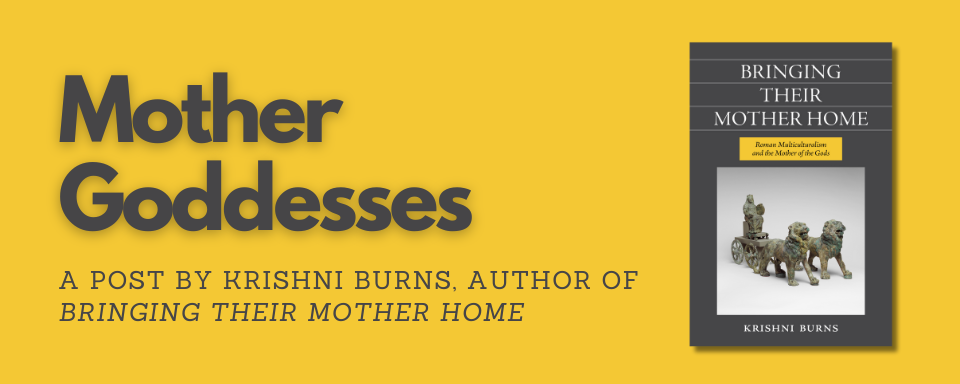
This guest author post is by Krishni Burns, author of Bringing Their Mother Home: Roman Multiculturalism and the Mother of the Gods. The book is now available in hardcover and accessible ebook formats.
Today, Americans have a very clear idea about what it means to be a mother. Despite Betty Friedan’s The Feminine Mystique, the Women’s Liberation Movement, and the fact that raising children on a single income is nearly impossible in the 21st century, the shadow of the 1950s housewife still looms large. Women are expected to put their children before everything, even when they have co-parents who are equally responsible for childcare.

A portrait of a Roman woman dressed as the Magna Mater. 1st Century C.E. Currently at the Getty Villa. This image was taken from the Getty Research Institute's Open Content Program. Author Unknown.
Recently on a family vacation, my female cousins and cousins-by-marriage planned a girl’s night out. One of my aunts asked a cousin’s wife who was taking care of her baby for the night, she answered promptly “his father.” I don’t mean to cast shade on my aunt, who was angling for extra baby time, but the fact that her own son, the baby’s father, wasn’t the obvious caregiver shows just how ingrained the idea is that mothers remain the only people capable of caring for their children. In many ways, this is a shame. My uncle has been enjoying his first grandson and plays an active part in caring for him, including the unpleasant, diaper-changing, fussy-baby-comforting bits. Looking back on raising his own kids, he regrets how much of their childhood he missed.
Even so, we still default to an idea of motherhood as all-encompassing, even as we acknowledge that mothers are also their own persons, and everyone’s experience of motherhood is both idiosyncratic and complex. The Ideal Mother is nurturing and self-sacrificing. She will do anything for her children. This vision of the patient, generous, bountiful nurturer finds its most pure expression in the concept of Mother Nature.
The modern popular archetype of the Great Mother Goddess, aka Mother Nature, was codified in the 1970s, when the Women’s Lib. fed interest in ancient matrilineal societies, who supposedly worshiped a benevolent personification of the Earth as a ferality goddess, the Great Mother. Scholars Robert Graves and Marija Gimbutas were instrumental in developing this concept, and her work was made popular by second wave writers like Merlin Stone and Riane Eisler. Joseph Campbell, the professor of literature who proposed the universal myth of “The Hero’s Journey” reinforced the idea of the Great Goddess through a series of essays and public workshops.
In this theory, the original peoples of Europe were part of a peace-loving matriarchal society who worshipped a Great Mother Goddess. These gentle farmers overthrown by the brutal, patriarchal Indo-Europeans, who invades from the Russian Steppes (Cold War much?) ended the golden age of matrilineal peace, subjugated the gentle mother goddess worshipers and imposed their own wrath-filled Sky-God on the Mediterranean world. Supposedly, said the mother goddess movement of the 1970s, this was the problem with our modern society. We were too patriarchal, too militaristic. If we could simply return to our true Great Mother Goddess roots, we could put an end to the cycle of war and violence that culminated in the Vietnam War and oppressive gender inequality.
Sadly, reality is never that simple. Thanks to many archaeological discoveries, we know now that the prehistoric Europeans were as militaristic as any society whose people need resources to thrive. The Indo-Europeans existed, but there’s more evidence that they migrated across Europe gradually, rather than executing any large-scale conquest, and we definitely don’t know where they were originally from. The vision of prehistoric matriarchal societies, while not completely disproved, has likewise been complicated by a lack of evidence. Those facts don’t stop our vision of an ancient Great Mother, who, like Shel Silverstein’s Giving Tree, will sacrifice her very existence to provide for her children: humanity.
The modern Great Mother archetype says a lot more about our relationship with nature than it does about how ancients conceptualized mother goddesses. Most North Americans are far removed from the natural world, behind our insulated walls, in our centrally heated homes and offices. Around 80% of Americans today live in cities, where food comes from grocery stores, not the ground. Nature can be bountiful, true, but it is also red of tooth and claw. In the ancient Mediterranean world, few people starved, but the majority of the population were subsistence farmers, facing food insecurity, malnutrition, and disease. They knew that the natural world belonged to bears, wolves, and, above all, lions.

Arslankaya (Lion Rock) Monument, 6th century B.C.E. Phrygian. Located near modern Döğer, in Western Central Turkey. Photo by Lynn Roller, 1985. Reproduced with permission.
When the people of the ancient Mediterranean envisioned a Great Mother, they never expected her to be kind. They knew that she was powerful and worshipped her accordingly. Matar (“Mother”), the Mother Goddess from ancient Phrygia, in what is now Turkey, was most strongly associated with borders, not children. In fact, we have no evidence that she had any children. To be fair, there are only a few fragments of surviving inscriptions in Phrygian, and most of the surviving images of Matar are highly eroded statues. Still, we would expect her holding an infant or two. But no, the relief of Matar in the now-defaced Arslankaya Monument is holding rearing lions, or maybe griffins, by their throats. Matar is never found presiding over the fertile plains where crops grew. Instead, monumental statues of Matar are found carved into mountainsides, where she guarded borders against invasion. One of her titles was Kubeleya, “the Mother of Mount Kubel.” When her worship made its way west to the Greek speaking Aegean Sea, they called her Meter (“Mother”) and named her Cybele.
Cybele in the Greek world became associated with Rhea, the mother of the Olympian gods, and Demeter, the mother of Persephone and goddess of the harvest. However, she was still no self-sacrificing nurturer. In Euripides' hymn to Demeter/Cybele in his play Helen, she seeks to destroy the whole human race in her rage for her lost daughter (1320-1337). Meter appears on the Altar of Pergamon as Rhea/Cybele, riding a lion into battle against the giants.

The goddess Rhea from the Pergamon Altar, 2nd century BCE. Located near modern İzmir, on the West coast of Turkey. Reproduced under the Creative Commons Attribution-ShareAlike license.
When the Romans brought Cybele to Rome, they called her Mater Deum Magna Idaea “the Great Mother of the Gods from Mount Ida.” Mount Ida was close to ancient Pergamon, and it was Pergamon’s lion-riding warrior that the Romans wanted. They were in the last stages of their great war against the Carthaginian general Hannibal, and they wanted a divine defender on their side to be the patroness of their victory. At one point, years before, Hannibal had threatened Rome’s very gates, and Rome brought Cybele from Pergamon right before launching a retaliatory campaign against Carthage to show their enemies that the Great Mother Goddess was on Rome’s side. The Romans gave their Magna Mater a crown of city walls to show that she was their eternal protector, who would keep their fortifications safe against any outside threat, and a chariot drawn by lions to show that all of nature bowed before her power. She could be terrible to those who wronged her. In the first century BCE, the poet Catullus wrote to her “Dea magna, dea Cybēbē, dea, domina Dindymī,/ procul ā meā tuus sit furor omnis, era, domō;/ aliōs age incitātōs, aliōs age rabidōs.” (63.91-93): “Great Goddess, Goddess Cybele, Goddess, Mistress of Mount Dindymon,/ may all your fury be far from my home, Lady;/ drive others to frenzy, drive others to madness.”

Bronze fountain statue of Cybele riding in a chariot drawn by lions. 2nd century CE. Photo courtesy of the Metropolitan Museum of Art.
This version of a mother goddess is very far from the Giving Tree, or the peace-giving nurturer of 1960s imaginings. However, it is very much in line with a new version of motherhood. Recently, biologists have published findings that social vertebrates, including humans, are neurogenically wired to have a nurturing response to members of their social group, but a hostile response to outsiders. This has come to be known colloquially as the “Mama Bear” effect, or, more formally, the Tend-and-Defend instinct.
The Roman’s Magna Mater was certainly a defender, as were her earlier iterations of Meter and Matar, going back to the early Iron Age. Today we often wish for a mother to bring comfort and safety, but the Romans knew that safety is something that you have to be prepared to fight for. Their mother goddess was never self-sacrificing, sometimes terrifying, but was always powerful, always great. Personally, I don’t want to give up my whole self just to make my children happy, but I am grateful to live in a time and a place where I can dream of a Great Mother who brings peace, instead of keeping a wall between me and war. If only all the world could feel the same.
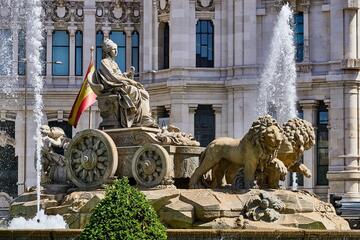
Statue of Cybele by Francisco Gutiérrez Arribas. It is the central sculpture in the fountain of the Plaza de Cibeles, Madrid, Spain. This file is made available under the Creative Commons CC0 1.0 Universal Public Domain Dedication. Photo by user Naknaknak.


