
The International Politics of Communication
Representing Community in a Globalizing World
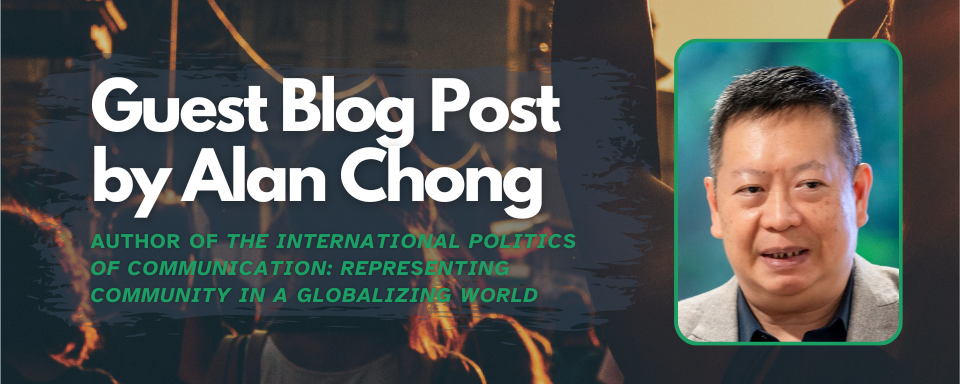
This guest author post is written by Alan Chong, author of the new book The International Politics of Communication: Representing Community in a Globalizing World, from the University of Michigan Press. The book is available in hardcover, paperback, and open access.
Today’s furor over disinformation/fake news, hybrid warfare and the cancelling of incorrect views on social media, university curricula and museums are both new and time-honored. My new book The International Politics of Communication calls attention to this duality. Controlling or shaping information is a potent arsenal of both big powers and small states. Information instruments are equally the weapon of choice for non-state actors, whether they are liberation organizations, terror groups or humanitarian agencies.
The International Politics of Communication addresses information politics in terms of how information can be manipulated to affect opinion with and without the consent of sovereign authorities. Today, owning a social media account or gaining preferential access to satellite TV channels is indispensable to making a play for global power. Social media engages followers. These audiences serve as vessels for conveying the virality of information dissemination. Satellite TV defines breaking news and trends. It may be in competition with social media, but it has its hold on its own loyal audiences.
Today practically all media companies, governments, and private corporations have found ways to build public relations complementarity between social media and television media. Messaging is now the art of 24/7 storytelling through multiple avenues. Here are additional sound bites from my book:
My book discusses NATIONALISM from the angles of producing myths and historical events; living memories and creative imaginations. The techniques behind today’s MAGA, Indian nationalism, and the Chinese Dream are covered as information politics.
SOCIETIES UNDERGOING DEVELOPMENT are tied intrinsically to how their communication cultures shape the use of technologies from paper to television to Internet portals, and to social media. These cultural and local filters help frame an imagined idea of progress or contentment.
TRANSPARENCY and GOOD GOVERNANCE – Making information and raw data visible and accessible to outsiders potentially puts them on par with insiders – and may alter power relations between insiders and outsiders. International Organizations, too, enjoy the power to sanction after disclosures are made by contracting parties under their rules and norms.
Finally, last but not least, The International Politics of Communication links readers with the tools of information socialization. In this era of spin and fake news, propaganda requires making instrumental choices for white, grey and black strategies in tandem with the doctoring of images to project sharp or subtle messages to multiple audiences. Schools, universities, educational agencies, think-tanks, tourist bodies, philanthropic entities, museums, social media activists, civil society individuals, film producers, actors and cinematic script writers are all natural actors in political communication across all sovereign borders. These are not odd, innocuous subjects in a mass media course, these are vital socialization tools in an age as information saturated as ours is!


