Q&A with Transformismo Author M. Myrta Leslie Santana

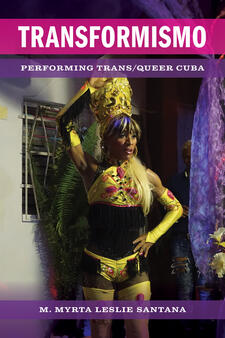
This guest author post is a Q&A with M. Myrta Leslie Santana, author of the new book Transformismo: Performing Trans/Queer Cuba, from the University of Michigan Press. The book is available in hardcover, paperback, and accessible ebook.
Can you tell us a little bit about transformismo and what the word describes?
Transformismo is a word used in Cuba and elsewhere in the Spanish-speaking Americas to refer to what we would call drag performance in English in the US. It describes the work done by transformistas, or drag performers, and you can further specify transformismo masculino (drag king performance) or transformismo femenino (drag queen performance), and likewise transformistas masculinos (drag kings) or transformistas femeninas (drag queens).
Some people I spoke with in Cuba distinguished transformismo from “drag,” and certain scholars have also noted important distinctions between the two. In Cuba, I think folks were pointing to the fact that there are lots of different kinds of transformistas or that transformismo shows often have a kind of cabaret or variety show structure. Some scholars, meanwhile, have suggested that the term transformista is a bit more closely tied to transgender subjectivity than “drag performer” is in the US. In my research, however, I came to feel that the kinds of social and aesthetic diversity I saw in transformismo resembled the social and aesthetic diversity I am familiar with in what we call “drag” in the US. So, though translations are always incomplete, I chose to simply translate transformismo as “drag performance” in the book.
Finally, transformismo has some other meanings that might influence the way we understand its usage to refer to drag. In theater, transformista can refer to quick-change artists who transform their appearance or clothing rapidly onstage. This is, of course, something certain drag performers do from time to time, and it also highlights the importance of “transformation” within transformismo, of a change or amplification of one’s everyday gender presentation. In the sciences, transformismo refers to the theory of evolution, which is fortuitous, because certain artists I discuss in the book imagined an evolution of the Cuban Revolution that would make greater space for trans and queer Cubans and their needs. These kinds of aims are, to be sure, at the heart of Transformismo.
What was the most challenging part of writing the book?
Making time to write it! Transformismo draws from research and writing I did for my dissertation, but it is entirely reworked and significantly expanded. Since I went straight from my PhD program to a tenure-track job—which is a luxury, to be sure—I was working and teaching a ton over the five or so years I was writing the book after graduate school. This meant that, like most professors, I had to seek out time away from teaching so I could focus on the book, I had to make diligent use of breaks, and I had to make sure I was pushing the writing forward during the academic year.
But I really can’t complain. I had a very meaningful and rewarding time writing the book. Transformismo deals so closely with topics of deep personal importance to me as a trans lesbian member of the Cuban diaspora. In writing it, I got to spend time thinking about Cuba, performance, and racialized gender and sexuality in ways that enriched my own understanding of my, my family’s, and my ancestors’ places in the world. So, despite the challenges, it was a privilege to make time for Transformismo.
Congratulations on publishing your first book! Now that you have been through the process, do you have any advice for others working on their first book?
Paso a paso. Or “bird by bird,” as Anne Lamott has put it. The book feels so big, daunting, impossible when you are starting out. But Transformismo, at least, was not written in a day or over long stretches of dedicated time. It was written in the small, daily, routine writing that professors have been doing for so long. In the quiet 45 minutes before the teaching day starts, or the 30 minutes between classes. It was a project I was chipping away at, not something that came pouring out, however welcome that might have been.
Some reading this might be able to tell that I was deeply influenced by participating in the Faculty Success Program of the National Center for Faculty Development and Diversity early on the tenure track. Now, as a coach in the same program, I get to work with faculty at the beginning of the tenure track who are faced with the overwhelming demands of the next six or so years. And I get to witness the ways that incremental, routine writing helps to get us where we need to go while making space for the lives we want to live. Because life can’t be all work! I did indeed write Transformismo on the tenure track, but I also got married, I medically transitioned, I adopted a fabulous dog, built family in San Diego, and regularly visited chosen family and family of origin in Cuba and the US. So, write a little bit every day, and don’t stop living on the tenure track!
Readers might not know that you have also studied violin performance. Did your experience with music and performance help you connect with the artists you interviewed for the book?
I think so! My background certainly gives me enormous respect for people who are trying to make a living with their art, who are getting on stage to—among many other things—make a buck. It is hard to do, and yet it is easy to downplay the economic side of the arts in favor of its aesthetic flair. But artists have to eat! So, I tried to really listen to transformistas as they talked about all of their concerns, about why it was they were getting on stage in heels, makeup, and a stunning dress.
I also brought my violin with me to Cuba for my long-term research. This was great for me, because I had more time to practice than I usually do, and I was able to get my chops back. And I was also delighted to share my playing with anyone who would ask me to. I played at a cumpleaños de santo, celebrating someone’s initiation in Regla de Ocha; I played at the funeral of a father of a close friend; I played at another friend’s beautiful wedding on the beach. And, yes, I played at a drag show. You can read all about that in Chapter 5 of the book!
What do you hope readers will take away from Transformismo?
I hope, in these times especially, that readers see that the people I wrote about were finding ways to live with dignity and to cultivate pleasure despite the extremely challenging circumstances surrounding them. The horrific blockade of Cuba by the US makes even the most basic of tasks hard to accomplish, and that is punishing for Cubans of typical means. But, as readers of Transformismo will see, trans and queer Cubans are not waiting to be told their lives are valuable, not waiting to have the resources they desire and deserve, before they lead the kinds of lives they want to lead. They are doing it right now! Whether they are hosting a party, putting together a social project, starting a troupe of transformistas, or going to the Malecón with some friends. In doing so, they are following in a long line of transformistas who did the same, putting on drag shows in forced labor camps, immigrant detention centers, and AIDS sanatoria.
We will need to learn from this in the US as we women and trans and queer people lose access to rights and privileges we enjoyed and for which people fought tremendously hard. We know that the kinds of attacks on trans people being made by the Trump administration have the explicit purpose of discouraging trans people from transitioning, urging us instead to leave the country or—devastatingly—to end our own lives. The state will make our lives very hard in the coming years. But the state has never told me that I am a woman or that my life is worth living! That I get from myself and my people. I get that, to be sure, from so many of the transformistas and drag performers getting on stage throughout the Americas to cultivate trans/queer space that is beautiful, wild, and free. So, I hope readers of Transformismo get a sense of some of the ways trans and queer people, despite all that is going on around us, continue to craft fabulous lives.