Celebrate Black History Month with UMP

In honor of Black History Month, we’re sharing a few titles from the University of Michigan Press that bring awareness to Black history, culture, identities, and contributions in the United States, as well as bringing to light the racial prejudices and systematic inequalities that continue to challenge us today.
Below is a selection of some of our new and upcoming titles. We invite you to explore our African American Studies lists for more titles to read this month! Many of the featured titles are Open Access, so start reading today!
Hurt, Baby, Hurt by William Walter Scott, III
The 1967 Detroit Rebellion was the bloodiest of the urban riots in the United States during the “Long hot summer of 1967.” Hurt, Baby, Hurt takes a personal look at the Rebellion from the perspective of William Walter Scott, III. The Rebellion began when police raided an unlicensed drinking club owned by Scott’s father and continued for five days, resulting in forty-three deaths and even more injuries, fires, and arrests. Scott is widely recognized as the man who started the Rebellion by throwing a bottle at one of the police officers and this memoir recounts Scott’s life from his birth up through the Rebellion. It tells the story of how the Rebellion started and provides an on-the-ground account of the Rebellion and its immediate aftermath, including the police detainment of the people involved.
A Domestic Cook Book: Containing a Careful Selection of Useful Receipts for the Kitchen by Malinda Russell
A Domestic Cook Book (1866) by Malinda Russell is the oldest known published cookbook written by an African American woman. Containing 260 recipes and household tips that draw from Malinda Russell’s twenty years of experience cooking in Southern kitchens, her boarding house, and her pastry shop, this new edition includes a foreword by scholar Rafia Zafar as well as an introduction by the late food historian Janice Bluestein Longone that contextualize Russell’s cookbook. Using the only known copy of the original book, this new edition preserves an important part of Michigan and American history and makes it widely available to readers for the first time. The Ann Arbor District Library will be hosting an in-person (and livestreamed) panel discussion about the book on February 27th. Details here.
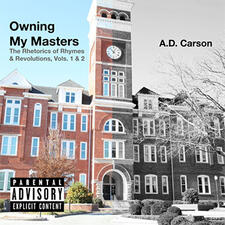
Owning My Masters (Mastered): The Rhetorics of Rhymes & Revolutions by A. D. Carson
In Owning My Masters (Mastered), A.D. Carson exposes the artificial boundaries imposed on understood ideas about knowledge production in academia by employing hip-hop creative and compositional practices to interrogate ideas of citizenship, history, historical imagination, race, home, and humanness. The unmastered album was originally the author’s dissertation, composed against the backdrop of the growing unrest across the U.S. and the world in response to the public attention to the deaths of Black people, many at the hands of police and vigilantes. As such, the songs highlight outlooks on Black life in America—on campuses and in communities across the country—and how they fit with geographic and temporal place and space.
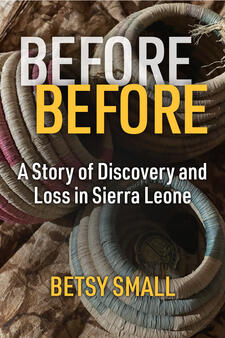
Before Before: A Story of Discovery and Loss in Sierra Leone by Betsy Small
Before Before captures daily life in Sierra Leone, where Betsy Small first visited as a Peace Corps worker, and then rediscovered when she returned decades later with her daughter. Living in Tokpombu, a remote community of forty rice-farming families, the author faced struggles that changed her forever and witnessed the growing tensions in this rainforest village—between the young and old, between the traditions of oral history and honoring the ancestors valued by the elders and the siren call of the illicit diamond mines faced by the youth
Prince, Musical Genre, and the Construction of Racial Identity by Griffin Woodworth
This volume takes a fresh look at Prince’s work, arguing that his music was deeply informed by the history and techniques of Black culture, and that his multigenre fluency and changeable image were weapons that he deployed in a career-long fight against the racially segregated structures of the American music industry. By tracking Prince’s transformations of instrumental and vocal idioms derived from specific musical genres, and considering the historical and cultural values embedded within those genres, Prince, Musical Genre, and the Construction of Racial Identity explores the ways that Prince musically broke down stereotypes of Black masculinity.
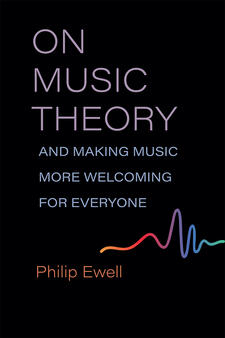
On Music Theory, and Making Music More Welcoming for Everyone by Philip Ewell
2024 PROSE Award for Music & Performing Arts Winner
Since its inception in the mid-twentieth century, American music theory has been framed and taught almost exclusively by white men. As a result, whiteness and maleness are woven into the fabric of the field, and BIPOC music theorists face enormous hurdles due to their racial identities. In On Music Theory, Philip Ewell brings together autobiography, music theory and history, and theory and history of race in the United States to offer a black perspective on the state of music theory and to confront the field’s white supremacist roots. Taking an explicitly antiracist approach to music theory, with this book Ewell begins to create a space in which those who have been marginalized in music theory can thrive.
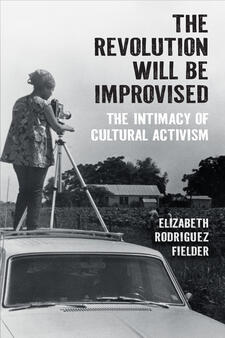
The Revolution Will Be Improvised: The Intimacy of Cultural Activism by Elizabeth Rodriguez Fielder
In the 1960s, Student Nonviolent Coordinating Committee (SNCC) activists engaged with people of color working in poor communities to experiment with creative approaches to liberation through theater, media, storytelling, and craftmaking. With a dearth of resources and an abundance of urgency, SNCC activists improvised new methods of engaging with communities that created possibilities for unexpected encounters through programs such as The Free Southern Theater, El Teatro Campesino, and the Poor People’s Corporation. Reading the output of these programs, The Revolution Will Be Improvised argues that intimacy-making became an extension of participatory democracy. In doing so, Fielder supplants the success-failure binary for understanding social movements, focusing instead on how care work aligns with creative production.
Readying the Revolution: African American Theater and Performance from Post-World War II to the Black Arts Movement by Jonathan Shandell
Readying the Revolution explores the dynamic era of Black culture between the end of World War II and the start of the Black Arts Movement (1946-1964) by illuminating how artists and innovators such as Jackie Robinson, Lorraine Hansberry, Ossie Davis, Nina Simone, and others helped radicalize Black culture and Black political thought. Through archival research, close textual reading, and an analysis of performance artifacts, Shandell demonstrates how these artists negotiated a space on the public stage for cultivating radical Black aesthetics and built the foundation for the revolutionary movement in Black theater that followed in the mid-1960s.