Q&A with Author Shiri Noy
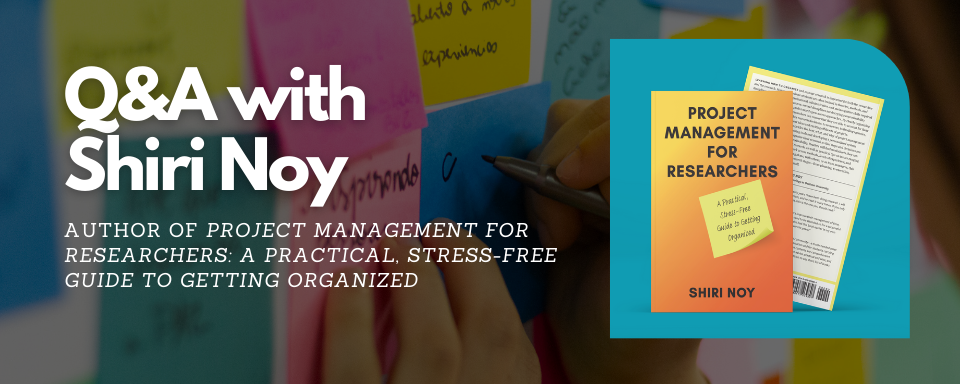
This guest author post is a Q&A with Shiri Noy, author of the new book Project Management for Researchers: A Practical, Stress-Free Guide to Getting Organized, from the University of Michigan Press. The book is available in paperback and accessible ebook formats.
What inspired you to write Project Management for Researchers?
So much of the work that researchers do is at the cutting edge of our fields and we spend so much time getting specialized training in our methods and theories, and doing things like learning how to use specific software, and thinking deeply—and that is so much fun and so exciting. I feel fortunate to get to research the things I want to know more about, and be surrounded by smart people to have conversations with that move my thinking and my work forward. In those conversations, and in my mentorship relationships (both as mentor and mentee) I realized that we spent so much time picking each other’s brains about how we organize our work, time management, and workflow. And in collaborative relationships we spend time negotiating the different ways that we prefer to do things. This made me realize just how little training any of us get on the organizational side, which requires some real metacognitive and administrative skills and strategies.
Having an effective research project management system frees us up to do the work we need and want to do, and ensures that we’re not misaligned with our overall goals, values and ethical commitments, and the expectations that we and others (collaborators, students, supervisors, institutions, and other stakeholders) have for our research. I believe that this lack of attention to what I call the project management side of research comes at a great cost, not only to the research where we’re more likely to make mistakes, miss things, and so forth, but also to ourselves as researchers. It means we’re often more stressed out and less able to devote attention to the things that matter and the substantive side of the research.
I wrote this book, in short, because I wish I had it when I was “coming up” as a graduate student and faculty member, and because I still use its strategies. Your research project management system is not static, it needs to be responsive to change and different demands, and there’s actually a way to tweak, improve, and adjust it in a systematic, rather than ad hoc way, as I explain in the book.
In your introduction, you discuss how organizing research is good for the researcher, the research, employers, and the stakeholders of the research. Is there a particular benefit to the researcher that you think is underdiscussed?
In my conversations with scholars, my experience is that nearly everyone is looking for ways to improve how they manage their research. Further, again, based on the conversations I’ve had, most researchers indicate that they don’t feel great about how they organize and manage their research. Now, as I talk about in the book, feelings aren’t facts, but they are real. What I mean by that, is that sometimes you feel like something isn’t going well, but that might not have much basis in reality in terms of outcomes or how other people perceive it. However, that matters little if you continue to feel bad about it. One of my biggest goals is to help you feel better about and in your research. This seems to be the case for a lot of researchers: they get their work done, but the cognitive and emotional toll it takes is higher than it should be as they scramble to find things, worry about where they put files, what they named a dataset, have a hard time recalling when they corresponded with a research assistant about such-and-such topic, have trouble finding the citation for such-and-such concept, and the list goes on. So I would argue that in addition to the benefits that are perhaps are a little more obvious: better—meaning more accurate—research, more efficiency in your research (though I want to be clear, I do not promote efficiency to suggest people do more work, we do a lot), better accountability for decisions made about your research, and research that is aligned with your values and ethical commitments, one of the biggest benefits is that researchers can feel better—more relaxed, in control, and capable—by purposefully implementing a research project management system.
Even if a researcher wants to get organized, they may feel uncertain of where to begin. What is your number one recommendation to researchers before they start their research project?
I think that this is a common misconception, that organization is only or most important in the execution stage of research: that is, while we are doing the research. The book is divided into three main sections (with a fourth shorter section on making things more fun and other tips) that deal with the three areas where I really think we as researchers need to get organized and manage: planning, execution, and adjustment. We often think about the execution, things like workflow, naming files, naming variables, version control on drafts and so forth. But, having a system for planning and adjustment is just as important! We can’t get where we’re going successfully nor easily without a good map and plan, and I think the same holds true for research. Many researchers are resistant to planning carefully, with good reason, arguing that it’s so hard to plan in detail for research. Research is about new discoveries, and there are so many dead ends, offshoots, and side quests!
However, I argue that research not only allows for careful and detailed planning, but in fact, it requires it. We want to make sure that we are using our resources (financial, cognitive, physical, and so forth) effectively and we’re much more likely to get lost without a map. Perhaps even more salient, when things inevitably go sideways, by having a clear plan and a clear understanding of our goals and hoped-for outcomes and outputs, as well as a clear sense of our ethical commitments, we can adjust productively rather than reactively, from a place of knowing what resources we have at our disposal and where we want to go, rather than from a place of putting out fires and responding from a place of panic and in a haphazard manner.
The book has lots of tips and examples, but I think even more importantly, it has principles that are adaptable to each researcher’s and each project’s circumstances and needs. Broadly, though, I think the biggest tip is to be really clear on your goals and your values, so that every decision you make in organization, management, and administration is consistent with those goals and values. Perhaps the simplest and most straightforward tip—that I, and many others, learned through painful experience—is to back up your work. In the book I talk about the benefits and drawbacks of using external drives versus cloud storage, but those are just different tools for the same purpose. Regardless of whichever you choose, back up your work!
How has learning about different methods for organizing research helped you in your own work?
As my friends know, I am a lover of advice. I love both getting and giving advice. I also think that there is something so productive, and almost magical or alchemical, about brainstorming and thinking together. You start with a problem, and you end up with some ideas, and hopefully a sense that the problem has some solutions. A lot of the way that people organize research comes from trial and error, but in my conversations with scholars, a lot of it also comes from talking to others, emulating their strategies, and if they’re lucky, learning some tips and tricks from their advisors. Equally important is knowing what will not work for you. When learning about how others do things, and receiving advice and tips, I am a gatherer, but I am not quick to implement everyone’s advice. This relies on some trial and error, but also a deep and solid knowledge and acceptance of who I am. Never say never, but I doubt I will ever be a person who starts their day with an hour of writing at 6a in the morning, though I know a scholar that does, and it's a great approach. I encourage researchers in the book to get really clear on their goals and ethical commitments. Then, accounting for who you are, practicality, and the types of data, information, files, people, and so forth you are organizing—and to be clear, people may be just you, the investigator, or it may be a team of three dozen people!—craft a system that accounts for your own strengths and weaknesses. So in a way, the thing that has helped me most is not just learning about what other people are doing, but why and how those approaches work for them, which allows me to learn which of those strategies might work for me and which are just not compatible with my ethical commitments, working style, and goals.
What do you hope readers will take away from Project Management for Researchers?
I really hope they take away two big things: first, that they should have a project management system, that it will pay dividends for themselves, their work, and their organizations. Second, I hope they take away a system that is aligned with their goals and ethical values.
The book is summarily practical by design: it has worksheets for readers to work through as they craft their own system and many examples and tips. Blank worksheets are available for download from the book’s companion website and my website so that readers can build their research project management system as they read. My hope is by the time you finish the book, you are convinced that developing a system is important, and you actually develop your system from start to finish! The book walks you through developing your system, including refining your goals and intended outputs and outcomes, gaining clarity on your ethical commitments and your researcher characteristics, selecting the appropriate tools for your work, developing a clear workflow for naming and organizing folders, files, and data, a check-in system to diagnose issues that might come up and create accountability, a basis for making appropriate adjustment, and more. That is, the book provides a one-stop resource for building a system that works for you and that you can continue to refine and adapt, whether you’re a first year graduate student just beginning your master’s thesis or a named chair with a multi-site, large grant-funded project involving several co-investigators and other personnel already underway.