
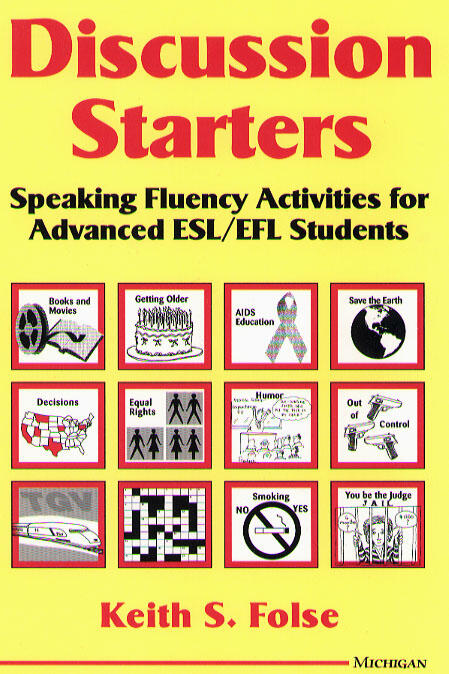
Discussion Starters
Speaking Fluency Activities for Advanced ESL/EFL Students
Thirty-two lively topics to stimulate classroom discussion for advanced ESL students
Description
One of the most common problems facing ESL teachers is the advanced speaking class in which the most confident students dominate the discussion and the weaker students quickly withdraw. Discussion Starters is designed to balance the oral participation of all the students in the class and thus promote an environment in which everyone has not only a chance but a real need to speak out.
Each unit contains a relatively small number of exercises (usually around five) which provide speaking interaction about a central topic or idea. In most of these activities, students must work together in pairs or small groups to reach a conclusion about a topic. Other discussion books on the market today often use imaginary situations for discussion (e.g., "If you had a million dollars, what would you do?"). The activities and tasks in Discussion Starters are real situations from all over the world. When students are asked what they would do in a given situation or how a judge should rule in a case, all the material is real.
Naturally, teachers may assign additional readings to supplement the topics in Discussion Starters; however, there is ample background material in the text to start students on their way to a discussion. Thus, students can spend their class time speaking about and discussing topics rather than reading about them. A unique and important feature of this text is the inclusion of homework exercises that call on students to sort out their ideas and opinions before coming to class. This allows all students to be prepared for the speaking activities in class and is of special importance to the weaker, less confident non- native speakers.