Q&A with Home Team Away Author Yuan Gong

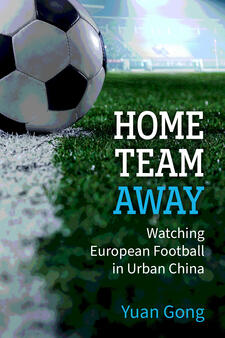
This guest author post is a Q&A with Yuan Gong, author of Home Team Away: Watching European Football in Urban China. The book is now available in hardcover, paperback, and open access.
What inspired you to write this book?
While my book takes a sociological lens to explore football fandom, its genesis has much to do with my personal affection for the world’s No.1 sport. Growing up in Shanghai, I became a keen viewer of the FIFA World Cup and the UEFA European Championship at age ten (when I watched Euro 1996), thanks to my dad. In 2010, I fell in love with the Spanish national team during their historic run of three consecutive major titles (Euro 2008, the 2010 World Cup, and Euro 2012). Following the Spanish players of this golden generation, I moved from international football to club football and was soon attracted to the melodramatic world of the Big Five leagues (La Liga, the Premier League, Bundesliga, Serie A, and Ligue 1) where a few of those players cemented their fame. Eventually it was Arsenal that won me over with its vibrant red and white jerseys and breathtaking attacking playing style, even though at that time the team was hitting a historical low during a five-year trophy drought. As my journey as an Arsenal supporter commenced, I soon discovered the huge Chinese fan following of the elite Big-Five clubs who were doing a variety of interesting things both online and offline. To a large extent, my curiosity about these fans who were more dedicated, passionate, and loyal than myself – the curiosity about why they were so obsessed with a football club so far away from them – is where everything about this book started.
Yet the more I knew about these Big-Five supporters through my doctoral research, the harder it became to ignore the fact that most of them are well educated, middle-class urbanites born after Reform and Opening-up (1978) and growing up in major Chinese cities like Shanghai, Beijing, and Guangzhou. This demographic breaks from the traditional image of football supporters in the West that is often tied to working-class lads. It also contrasts with the stereotype of patriotic Chinese citizens passionately cheering for their national teams at the Olympics. This book thus comes out of my interest in understanding the aspirations, pleasures, and frustrations of the Chinese middle class as manifested and embodied through their distinct ways of engaging with European football.
For me, a book that looks into the practices, thoughts, and feelings of European football fans also fulfills a long-held wish to document how Chinese people negotiate, reject, or distance themselves from the nationalist and anti-Western vibes that pretty much define cultural and political life in Xi Jinping’s China. While we’ve seen numerous accounts that express concerns about how sports and popular culture have become vehicles for the Communist Party to cultivate patriotism and nationalist ideology among Chinese people, I think it’s equally important to get to know the other side of the story regarding what’s actually happening in China - there are still overseas cultures and media products Chinese people are fascinated with and willing to spend a lot of time, money, and energy on. Therefore, I hope this book can provide an alternative lens for us to understand the Chinese middle class and contemporary Chinese society at large.
Are there any sports teams that you are a particular fan of?
As stated above, I was a huge fan of Spain’s 2010 squad and have supported Arsenal for over 15 years. I don’t consider myself as a hardcore football fan who can represent the Chinese Big-Five supporters in my book because most of my research participants are way more dedicated than me. What I usually do is just to watch some games on TV when I have time, and I haven’t taken part in most of the fan practices my participants conduct on a regular basis. However, some of my experience, including my visits to the Emirate Stadium in London and purchases of Arsenal’s jerseys, does fit the typical image of Chinese middle class fans whose cosmopolitan lifestyle affords them financial and symbolic resources to engage with the Big Five in particular ways.
2026 is a magical year for me both as a scholar and as a football fan. This year, Spain won their second World Cup and Arsenal finally became Premier League champions after a 22-year wait. This is the first time I’ve seen Arsenal get the EPL title since I decided to pick it as my home team. How serendipitous it is for my book to come out right alongside my teams’ long-awaited victories! I never planned it that way, but there is no better way for me to conclude a decade of conducting research and writing this book than this.
Did you encounter any particular joys or challenges when writing the book?
Writing this book brought me great joy by letting me rediscover many interesting findings buried in my field notes and share rich and nuanced stories about Chinese fans’ love for the Big Five – stories that rigidly formatted research outputs like journal articles often leave untold. I also really enjoyed the peer reviewing process. The eye-opening conversations I had with my editors and two anonymous reviewers helped expand and deepen the book in ways that I’d never imagined. I was trained as a media and communication scholar, so initially I planned to write a book only in response to the debates in fan studies and digital media studies. With their expertise in anthropology, sociology, and China Studies, my editors and reviewers inspired me to revise the book into a more ambitious project in dialogue with the rich bodies of scholarship in global middle classes, sports globalization, social transformation in China, etc. It’s not an exaggeration to say that writing this book transformed me - it broadened my knowledge and sharpened my interdisciplinary visions as a scholar.
That being said, this book is also the most challenging piece I’ve ever written throughout my academic career. Looking back I’m still amazed that my fear of writing a book in a second language was overpowered by my enthusiasm to share the stories about Chinese Big-Five fans with an international audience. As someone who’s never a fast writer even in their mother tongue, I have to admit that not a single chapter, section, paragraph, or sentence was easy to write. Finishing this book marks a major milestone in my life as it truly tested my limits. However, even harder than writing was weaving the bits and pieces I found about European football fans into a compelling narrative – one that not only offers a fresh lens on the Chinese middle class but appeals to readers within and beyond academia. Prior to this book, I was almost too used to the (dare I say, mechanical) convention of writing journal articles – raising questions, reviewing literature, and reporting findings. It did take me a while to adapt to book writing which gave me more freedom to build arguments yet required a warmer, more enchanting voice to connect with readers. While difficult, this transformation was an exciting journey I’m glad to have taken on.
Congratulations on publishing your first book! Now that you have been through the process, do you have any advice for others working on their first book?
As I mentioned in the previous question, writing my first book was very much a transformative process for me to switch to new ways of looking at and presenting research findings. If you want to turn your dissertation into a book (like I did), you probably need to be prepared for a complete rewrite of your core argument, structure, and style. In dissertations we are expected to demonstrate our familiarity with the theoretical and methodological traditions in our field and prove our ability to design and undertake independent research to a small group of academic specialists. This speaks in part to the convention of dissertation writing where we tend to use specialized vocabulary (e.g. technical jargons) and follow rigid academic templates (e.g. organizing the chapters around literature review, methodology, data analysis, discussion, etc.). In contrast, books are to be read by a much wider audience for educational, informative, or even entertaining purposes. This requires authors to be more innovative and creative in both knowledge production and storytelling. In books we focus more on advancing our original arguments than showcasing our knowledge about existing theories and literature. Book authors produce engaging, easy-to-follow narratives that open up readers’ minds and introduce new ways of seeing the world. In my opinion, understanding this difference is key to the successful transition from dissertation writer to book author.
My other advice is to work with a publisher that not only is interested in your work but takes first-time authors seriously. On this matter, I feel fortunate to have contacted UMP early in my book’s development. I still remember how swiftly my editor Sara Cohen responded to my initial inquiry and how smoothly the reviewing process went – this level of respect, care, and professionalism meant the world to me as a first-time author navigating the nerve-wracking process of pitching my book. So if you are writing your first book, I highly recommend you consider UMP if it is a good fit.
What do you hope readers will take away from reading Home Team Away?
The purpose of my book is to reveal why the Chinese middle-class is fascinated with the Big-Five leagues and how the middle-class subjectivity is formed through the transnational engagement with European football. Therefore, I hope my book will offer a unique window for my readers to look into the lived experience of the Chinese middle class at a historical moment when the Communist Party deploys new governing techniques to regulate people’s everyday life and maintain its authoritarian ruling.
In a broader sense, I also hope my book can encourage us to rethink what it means to be a fan, both in sports and beyond. European football fandom in China certainly calls for a rethinking of sports fandom as being divorced from an attachment to location. But more importantly, the practices of this fandom destabilize our conventional classification between the subversive, participatory fan communities and mainstream, individual fan consumers. In contrast to a lot of the findings in the Euro-American contexts that tend to separate communities and individuals as different types of fans with different levels of activeness, Chinese Big-Five supporters perform and mix the roles of individual, community member, consumer, producer, and activist through transcultural football engagement. My investigations of various Big-Five fan practices will show readers how Chinese middle classness is complex, malleable, and fluid – it never simply conforms to the normative discourse of citizenship dictated by the party-state. In this regard, Home Team Away can also be seen as a response to the heated debate over whether the middle class can drive social change and democratization in China. Even though growing material affluence might not directly lead to social movements that overturn the authoritarian regime, members of the Chinese middle class are able to secure alternative, border-crossing ways of cultural participation and perform a range of identities through them. In my opinion, the sense of empowerment and control they obtain from the Big-Five fandom forms a vital base for more radical forms of resistance contingent upon historical and socio-economic changes.