Serious Fantasy Literature in Japan
From Izumi Kyōka to Murakami Haruki
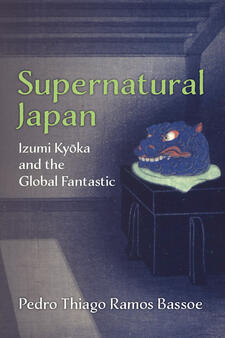
This guest author post is by Pedro Thiago Ramos Bassoe, author of Supernatural Japan: Izumi Kyoka and the Global Fantastic. The book is now available in hardcover, paperback, and open access.
It is clear that Japan has long served as one of the major suppliers of fantasy literature and media to fan bases across the world. Fantasy is a crucial element of many cultural products from Japan, such as manga, anime, and video games, that have come to visually represent aspects of Japanese culture to global audiences. What is less clear is how fantasy literature, particularly as prose fiction, fits into the wider continuum of Japanese media, or how the phenomenon of Japanese fantasy literature, known as gensō bungaku in Japanese, came to be.
Answering such questions was part of why I wrote Supernatural Japan: Izumi Kyōka and the Global Fantastic, in which I present the argument that the founding figure of modern fantasy literature in Japan was author Izumi Kyōka (1873-1939). In the book, I identify a group of influences that met during the formative period of gensō bungaku, including traditional Japanese ghost stories and tales of the supernatural; European literature by authors such as Hans Christian Andersen, Jules Verne, and Guy de Maupassant that were translated into Japanese; and Kyōka’s own creative contributions to the genre. As I continue to research fantasy literature and look forward, I believe that it is possible to identify different strata of “the fantastic” in Japanese literature and media, from the most popular, mass-produced variety (such as battle and adventure manga), to highbrow fiction, or the kinds of texts where popular themes and “serious literature” meet. Of course, boundaries and demarcations are not clear, although the tradition of serious fantasy literature in Japan is strong enough to identify it as a major path within the wider umbrella of global fantasy. In this blog, I argue that a line can be traced, more or less, from Izumi Kyōka to contemporary authors of literature of the fantastic, such as Murakami Haruki, Ogawa Yōko, Kawakami Hiromi, and others.
In the modern period in Japan, literature was historically divided into “pure literature” (junbungaku) and “popular literature” (taishū bungaku) by the literary establishment, a distinction that can still be seen in major literary awards, such as the Akutagawa Prize and the Naoki Prize, awarded to the best works of pure and popular literature respectively. Another major award, the Izumi Kyōka Prize for Literature, could be said to fall on the side of “pure literature,” albeit pure literature with elements of fantasy, romanticism, the supernatural, and an overall otherworldly atmosphere, thereby signaling a nod to the serious fantasy of the award’s namesake author. The books that win the Izumi Kyōka Prize might be said to rise to the top of the vast strata of fantasy literature in Japan in terms of artistic accomplishment, aesthetic complexity, and relevance to the concerns of serious literature, with works falling in various places on a continuum of realism, fantasy, and science fiction. Highlights of books that have won the award include The Tempter (Yūwakusha, 1976) by Takahashi Takako, Record of a Journey to the Country of Amanon (Amanonkoku ōkanki, 1987) by Kurahashi Yumiko, and Under the Eye of the Big Bird (Ōkina tori ni sarawarenai yō, 2016) by Kawakami Hiromi. Takahashi’s The Tempter, on one end of the spectrum, can hardly be described as fantasy, although its themes of morality, demonology, volcanoes, and suicide push it into dark, otherworldly territory. Kawakami’s Under the Eye of the Big Bird ventures deep into realms of sci-fi, with themes of mutants, robots, and AI, although with a complex, multilayered narrative that allows for multiple interpretations of individual stories, thereby suggesting the author’s central concern with the possibilities of narrative structure.
The question of the place of fantasy literature in the literary hierarchy first became relevant in the modern period during Kyōka’s own career, when the author alienated critics by turning from realism focused on social problems to fantasy stories featuring magical beings and supernatural creatures. Kyōka also wrote for both general audiences and serious literary enthusiasts, with work spanning from dramatic geisha stories that became popular on stage and later on film, to fantasy stories in a surrealist mode that have long challenged readers with their experimental literary style. Kyōka’s audience was diverse and is said to have included many female readers, in part because his stories frequently feature female characters in a variety of roles, including as teachers, nurses, actors, shop and café owners, geisha, maids, practitioners of traditional arts, thieves, rebels, princesses, goddesses, and various kinds of magical women. Kyōka also published some of his work in women’s magazines, a practice common among major writers in early-to-mid twentieth century Japan.
Drawing a line from Kyōka to contemporary fantasy literature is not straightforward, because Kyōka’s highly individual style has not often been imitated (if ever), he had no real literary pupils, and he belonged to no literary groups. However, a number of Japan’s most famous and critically acclaimed writers have praised Kyōka or indicated his influence on their work, including Tanizaki Jun’ichirō, Kawabata Yasunari, Akutagawa Ryūnosuke, Yoshiya Nobuko, Kōno Taeko, Kanai Mieko, Tsushima Yūko, and Mizuki Shigeru, among others. Although it is difficult to draw a direct line from Kyōka to today, one measure of his influence might be found in the Izumi Kyōka Prize for Literature. Founded in 1973, the prize, granted by the city of Kanazawa for works of literature that include dreamlike, surreal, or ghostly elements, has tended to identify works that exist on the peripheries of fantasy, oftentimes bordering on magical realism or romanticism, or even straightforward realism. One sees in the prize a desire to preserve a space of serious or “pure” literature of the fantastic, the uncanny, or the strange, as distinct from the world of mass media and popular entertainment, even if they overlap at times. This description of intersecting categories would also apply to Kyōka, whose work evinces the genre boundary-crossing often seen in serious fantasy literature today.
If Kyōka can be said to have started a trend, it would be the uniting of fantasy and realism, as well as pure and popular literature, in works that oscillate between literary registers. Others who followed this direction in at least some of their work include many of Japan’s most famous and acclaimed writers, such as Kawabata, Tanizaki, Takahashi Takako, Abe Kōbō, Tsushima Yūko, Ogawa Yōko, Murakami Haruki, and many others. Although there might not be a direct line of connection from Kyōka to Murakami, they both represent a tradition of Japanese literature that suggests an aspiration to become, at once, both highbrow art and popular literature for fans of ghost stories, otherworldly adventures, and surreal fiction. While it is difficult to compare Kyōka’s archly ornate literary style with Murakami’s plain modern language, the work of both authors suggests an attempt to give form to artistic visions that are grand, challenging, multilayered, and simultaneously rooted in the Japan of their times and mythical other worlds. Murakami is not often referred to as a fantasy writer (he is more often described as a writer of magical realism), although it is not difficult to identify works such as End of the World and Hard-Boiled Wonderland (Sekai no owari to hādo-boirudo wandārando, 1985) and The Wind-Up Bird Chronicle (Nejimakidori kuronikuru, 1994-1995) as fantasy, if not some of the best and most ambitious fantasy novels from Japan. With their sprawling underground labyrinths, ghostly or monstrous beings, and instances of magic, related alongside visually rich descriptions of settings in the real world, such works fit well within the modern tradition of gensō bungaku begun by Kyōka. Of course, many of Murakami’s literary influences are from outside of Japan, as were some of Kyōka’s, placing both within global networks of fantasy literature. Future research will probably reveal additional connections among texts and writers from throughout the modern period, in ways that elucidate the origins, development, and outstanding qualities of fantasy literature from Japan.