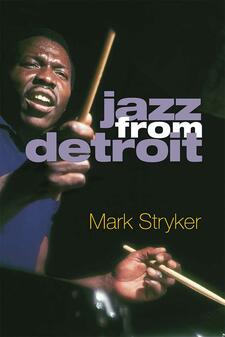
Q&A with Jazz from Detroit Author Mark Stryker

This guest author post is a Q&A with Mark Stryker, author of Jazz from Detroit. The book was published in hardcover and ebook in 2019 and is now available in a new, updated paperback.
Some authors say that the work on a book is never done. Do you believe that? And what was it like to return to your book to make changes?
Authors don’t write books; we adopt them. So, yes, I am one of those who believe that the work is never done. As soon as I turned in my manuscript for the final time before typesetting in 2019, my mind was already racing through all the changes that I wish I would have made to improve my writing, select a better word here and there, sharpen a metaphor, clarify a historical point, revise a critical judgement. After seven years, I STILL occasionally realize that I might have made some minor mistake in the text or forgotten to include a notable musician in the appendix. I’ll run to my bookshelf to check. If, in fact, I got something wrong, it ruins my day.
Then there is the fact that my own scholarship, listening, reading, and learning have continued. The opportunity to revise the book for the new paperback edition has been a gift – not only in allowing me to bring to bear new discoveries and ideas to the text, but also to simply polish the text and make corrections. A misspelling here, a stray comma there, etc. Some of these ghosts haunted me for years. I now sleep better.
What would you say are the most significant edits or additions to this new edition?
Before zeroing in on three changes that are particularly important to me, I will note that I have brought all the biographical chapters up to date. That means, for example, I have been able to chronicle the continued flowering of alto saxophonist Charles McPherson, who remains in great form at age 86. He has made some extraordinary recordings since Jazz from Detroit was first published and has at last begun to receive at least some measure of the critical and popular acclaim he has long deserved.
I have also been able to note the deaths of trombonist Curtis Fuller, singer Sheila Jordan, and pianist and bebop guru Barry Harris, whose critical role as mentor to so many other musicians made him the embodiment of the Detroit jazz tradition and the true hero of Jazz from Detroit. And I have changed my mind in several instances about a recommended recording listed at the end of every chapter.
Now, the three key edits I alluded to:
First, every reliable reference book available says that Curtis Fuller was born on December 15, 1934. He even confirmed that date to me in a 2012 interview. However, upon his death in 2021, an obituary writer for the Washington Post discovered that Fuller was instead born in 1932. Fuller’s daughter was able to cite government documents, including her father’s passport, that showed he was two years older than previously thought.
Second, several young Detroit musicians have become prominent in the last few years. While I did not have the flexibility to go into much detail, I was at least able to shout-out bassist Endea Owens, drummer Kayvon Gordon, saxophonist De’Sean Jones, and pianist Ian Finkelstein. These acknowledgements help underscore Detroit’s continued vitality as a city graduating jazz musicians to the national scene.
Third, the identity of the drummer on guitarist Kenny Burrell’s first recording as a leader, c. 1954-55 for Detroit’s J-V-B label, is not immediately clear from discographies or the memories of participants. I wrote in the first edition of the book that the drummer was likely the obscure Hindal Butts, who often worked with Burrell in those days. However, deeper listening has convinced me that the aggressive snap with which the drummer plays brushes and his notably wide beat on “Kenny’s Sound” is almost certainly the embryonic work of the innovative Elvin Jones. He also worked with Burrell in this period, and, assuming it is Jones, this would be one of his earliest recordings.
Readers might not know that you released a documentary, The Best of the Best: Jazz from Detroit, after the hardcover of Jazz from Detroit was published. Was there anything you learned as you worked on the documentary that you wanted to add to the new paperback?
Yes, but first a little background: I began working with two New York filmmakers – director and producer Daniel Loewenthal and producer Roberta Friedman – in 2020 on the documentary. The Best of the Best: Jazz from Detroit (2025), which I wrote and produced, is now streaming on Prime Video, YouTube TV, and Google Play, after a successful run of nine film festivals across the United States, Canada, and Europe. We are also screening the film at universities, museums, arts organizations, jazz clubs, and film societies throughout America and Canada.
Now to the question: It was through the making of the film that I learned about the key role that Grinnell Brothers Music House, a music store and piano manufacturer, had in nurturing Black musical excellence in Detroit through the middle of the 20th Century. Critically, the store did not discriminate and allowed African Americans to buy pianos on time. As both the rocket launch to a child’s musical education, as well as an expression of the upward social mobility and status of Black working and middle class families, the impact of a piano in the home (and de rigueur piano lessons) can’t be overstated.
Alas, the complications of trying to retrofit a layered discussion of the influence of Grinnell’s stores and pianos into a finite space made adding this information impossible in the paperback.
Yet the experience of working on the film is already influencing the course of my next book: a sweeping cultural history of Detroit in the 20th and 21st centuries that will cover both the so-called fine arts and vernacular arts, explore how closely tied the city’s cultural life has been on every front to Detroit’s unique history, and show how the city’s cultural influence nationally extends far beyond well-known popular music like Motown.
Jazz from Detroit is structured largely in biographical chapters. The connective tissue of Detroit’s economic, social, and cultural history and the trajectory of the city’s African American community is mostly expressed in introductory and thematic chapters and passages.
The film, however, places Detroit history, particularly the history of Black Detroit, in the foreground. Dan (the director) did a terrific job of weaving the music and history together in an organic fashion. That’s what I want to do in my cultural history – integrate the art into the marrow of city history to tell a more unified story in a more through-composed manner. The film offers a model.
How did your years reporting for the Detroit Free Press influence your approach to Jazz from Detroit?
I worked for the Detroit Free Press from 1995-2016 as an arts reporter and critic covering classical music, jazz, visual arts, and cultural news. The challenge in writing about any of the arts for general newspaper readers is finding a way to reach both experts and novices, who were at least interested enough to start reading your article. My 27 years in daily journalism, 21 of them at the Free Press, taught me how to do that. I applied those lessons to Jazz from Detroit.
Though Jazz from Detroit is not an academic book per se, I wanted to combine scholarship, reporting, criticism, and imaginative writing to bring these musicians alive on the page in a way that would speak to both aficionados and general readers. I wanted to offer a degree of formal analysis of the music without losing the average reader. I wanted to capture the sound and feeling of their music in words and present their lives on and off the bandstand. And I wanted to dig into culture and history, placing the musicians and Detroit into a larger context reflecting the music’s African American roots and relationship to a specific time and place. And I wanted the book to be fun to read. Others can decide if I was successful, but that’s what I was going for.
Do you have a favorite fact or story from the book?
It’s difficult to pick a favorite, but the first thing that comes to mind is my hilarious introduction to the great bassist Ralphe Armstrong, a character of Falstaffian proportions. I don’t want to spoil it for those who haven’t read it, so I’ll just direct folks to pages 284-285.