2025 International Open Access Week
The University of Michigan Press is excited to celebrate International Open Access Week! This year’s theme, “Who Owns Our Knowledge?” highlights the present moment and how, in a time of disruption, communities can reassert control over the knowledge they produce. Additionally, this theme challenges presses to reflect on who has access to education, how knowledge is created and shared, and whose voices are recognized and valued.
As part of our Press’s commitment to human dignity, we recognize the role we play in determining which voices are able to engage in social and academic discourses. We are committed to uplifting those voices by publishing Open Access monographs and providing our readers free, online access via our Fulcrum platform.
For this year’s theme, we’ve put together a list of OA UMP titles that challenges these questions of knowledge creation and ownership, access to education, and community-led approaches to knowledge sharing. Learn more about how this year's OA Week theme aligns with the our mission here.
Publishing Beyond the Market argues that the move to open access should focus less on the free accessibility of research outputs and more on who controls the publications and infrastructures for scholarly communication. By deploying theoretical literature on science and technology studies, care ethics, and the commons, the book critically interrogates open access and reimagines a more ethical future for researcher-led publishing. By illustrating how these projects build toward a commons-based publishing future, and how they may complement other approaches to publishing within university presses and libraries, the book culminates in an argument for the infrastructures, policies, and forms of governance needed to nurture such a collective vision. (For more, read an interview with the author here.)
In After Disruption: A Future for Cultural Memory, Trevor Owens warns that our institutions of cultural memory—libraries, archives, museums, humanities departments, research institutes, and more—have been “disrupted,” and largely not for the better. He calls for memory workers and memory institutions to take back control of envisioning the future of memory from management consultants and tech sector evangelists. After Disruption posits that we are no longer planning for a digital future, but instead living in a digital present. In this context, Owens asks how we plan for and develop a more just, sustainable, and healthy future for cultural memory.
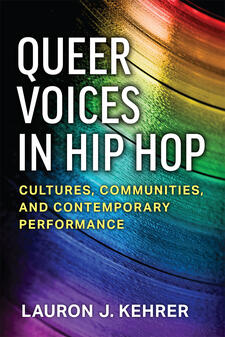
Lauron J. Kehrer’s Queer Voices in Hip Hop turns our attention to openly queer and trans rappers and positions them within a longer Black queer musical lineage. Combining musical, textual, and visual analysis with reception history, this book reclaims queer involvement in hip hop by tracing the genre’s beginnings within Black and Latinx queer music-making practices and spaces, demonstrating that queer and trans rappers draw on Ballroom and other cultural expressions particular to queer and trans communities of color in their work in order to articulate their subject positions. By centering the performances of openly queer and trans artists of color, Queer Voices in Hip Hop reclaims their work as essential to the development and persistence of hip hop in the United States as it tells the story of hip hop’s queer roots.
Academic Ableism brings together disability studies and institutional critique to recognize the ways that disability is composed in and by higher education, and rewrites the spaces, times, and economies of disability in higher education to place disability front and center. Jay Timothy Dolmage argues that disability has been constructed as the antithesis of higher education, often positioned as a distraction, a drain, a problem to be solved. Examining everything from campus accommodation processes, to architecture, to popular films about college life, Dolmage argues that disability is central to higher education, and that building more inclusive schools allows better education for all.
Empire and Environment argues that histories of imperialism, colonialism, militarism, and global capitalism are integral to understanding environmental violence in the transpacific region. The collection draws its rationale from the imbrication of imperialism and global environmental crisis, but its inspiration from the ecological work of activists, artists, and intellectuals across the transpacific region. Taking a postcolonial, ecocritical approach to confronting ecological ruin in an age of ecological crises and environmental catastrophes on a global scale, the collection demonstrates how Asian North American, Asian diasporic, and Indigenous Pacific Island cultural expressions critique a de-historicized sense of place, attachment, and belonging.
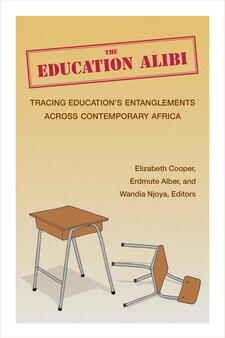
The Education Alibi asks if it is possible that while claiming to be doing one thing, education has also been doing another in African communities. The concept of the “alibi” shines an interrogative light on institutions’ and actors’ use of education to divert scrutiny from other effects. Through ethnographic research and critical analysis across the continent, this volume focuses on people’s lived experiences to demonstrate how contemporary education systems in fact deepen economic, racialized, gendered, urban-rural, linguistic, religious, and other intranational and international inequalities.
Focusing on the factors undermining the realization of disability rights in education, Translating Human Rights in Education probes current meanings of inclusive education in two contrasting yet equally challenged state parties to the UN CRPD: Nigeria, whose school system overtly excludes disabled children, and Germany, where this group primarily learns in special schools. Inclusion emerges to be an evolutionary and linear process of educational expansion that depends on institutionalized special education, not a right of persons with disabilities to be realized in local schools on an equal basis with others. This book proposes a refined human rights model of disability in education that shifts the analytical focus toward the global politics of formal mass schooling as a space where discrimination is sustained.
Creative Belonging (Forthcoming, January 2026) is based on years of ethnographic and textual-archival research in the Himalayan regions of southwest China, where the contemporary Qiang group resides. Drawing on a diverse range of official and local political discourses and previously unstudied literary, historiographical, and cinematic works, Yanshuo Zhang illuminates how the Qiang have carved out spaces of “creative belonging” within the parameters of multiculturalism in contemporary China. Creative Belonging invites readers to rethink ethnicity and national belonging in China by centering minority groups’ efforts to expand the meanings and implications of “Chinese culture.”