Understanding Chinese National Folk Dance
This guest author post is written by Emily Wilcox, translator of the new book Creating with Roots: Contemporary Chinese National Folk Dance Choreography, from the University of Michigan Press. The book is available in hardcover, paperback, and open access.
In the United States, the concept of “folk dance” evokes a range of connotations. For some, it recalls memories of dancing with relatives at a family wedding or taking lessons as a child at a local community center. Others may think of ad hoc performances they staged with friends in college as part of university cultural affiliation clubs. Still others teach or perform folk dance professionally with dance troupes and schools.
Although folk dance makes up an important component of the rich fabric of dance cultures in the United States, its presence there pales in comparison to that in China. Thanks to enormous state investment in professionalized folk dance training programs and performance ensembles since the 1950s, folk dance has emerged as both an academic discipline and a large-scale cultural industry. One regularly finds large-scale, high production value folk dance shows on stage in the many state-of-the-art modern theaters located in major metropolises around China. If someone is a professional dancer or choreographer in China, regardless of what form they practice, it is very likely that their early training was in folk dance. Folk dance also appears regularly on Chinese television and is an integral part of domestic tourism, making it highly visible in popular culture. It is also a nearly ubiquitous component of childhood extracurricular enrichment, especially for young girls. Folk dance is closely tied to expressions of national, regional, local, and ethnic identities in China. Thus, it is often featured in events celebrating state holidays and other events with political significance, of which there are many in contemporary China.
Given the different ways that folk dance exists in China and the United States, U.S. audiences often struggle to make sense of folk dance in Chinese contexts. This is true whether for folk dance in China or in Chinese diasporas. It is also true for audiences in other countries with their own distinct ecologies of folk dance performance and education and their own understandings of what folk dance is or should be. Folk dance is not a singular concept; it has multiple meanings and diverse practices around the world.
My new book translation Creating With Roots: Contemporary Chinese National Folk Dance Choreography, published open access by the University of Michigan Press, seeks to demystify Chinese folk dance and challenge some common misconceptions about it for English readers. Creating With Roots was originally published in Chinese by Dr. Rui Xu, president of the Beijing Dance Academy (BDA) and a prolific scholar, artist, and critic of contemporary Chinese folk dance. BDA has been China’s leading national educational institution for Chinese folk dance since it was founded in 1954, and Dr. Xu’s perspective carries great weight in China’s dance world. Creating With Roots is grounded in Dr. Xu’s original academic research, as well as his intimate knowledge of Chinese folk dance. The book shows his keen and perceptive awareness of how the field of Chinese folk dance has changed over time and the challenges it faces today.
A common misconception about Chinese folk dance is that because it is state-sponsored and connected to national identity, it must be unified and monolithic. In fact, as Xu shows in Creating With Roots, multiplicity and diversity have been constant features of folk dance in China throughout most of history. Dr. Xu touches briefly on folk dance in China prior to the twentieth century. However, his focus in Creating With Roots is on the period since the 1940s, when a form of Chinese folk dance for the concert stage—what is now known as “Chinese national folk dance” (Zhongguo minzu minjian wudao 中国民族民间舞蹈)—came into being as part of a larger project of establishing a modern Chinese national identity. As Dr. Xu demonstrates in Creating With Roots, there have been and continue to be diverse competing views about what Chinese national folk dance is and should be. Indeed, the approaches to Chinese national folk dance are as diverse as the people creating it, the new choreographies they develop, and the critics responding to and writing about it.
Another misconception about Chinese folk dance is that because it allows for creative artistic interpretation, it is somehow artificial or inauthentic. A major source of this confusion is the different definitions of “folk dance” in different languages. As Dr. Xu explains, Chinese national folk dance does not correspond to any single accepted category in English-language academic dance vocabulary. Terms like “ethnic dance,” “national dance,” “folk dance,” and “character dance” all express aspects of Chinese national folk dance but do not align perfectly with its meaning in Chinese. As a creative artistic practice for the stage, Chinese national folk dance employs choreographic ideas and strategies common to contemporary concert dance around the world. At the same time, it seeks to ground these creative practices in a deep understanding of historical and contemporary dance cultures indigenous to China.
Creating With Roots is not the first book in English to take on the difficult subject of Chinese national folk dance. My book Revolutionary Bodies: Chinese Dance and the Socialist Legacy, published open access in 2018 by the University of California Press, also centers Chinese national folk dance as a main theme. In it, I examine Chinese national folk dance and Chinese classical dance together as the two interrelated halves of Chinese dance. Indeed, this interconnected dyad of “folk” and “classical” must be understood together to fully appreciate the independent significance of Chinese national folk dance. Whereas Chinese classical dance takes inspiration from sources with national and historical significance such as Chinese opera, court performances of diverse Chinese dynasties, Buddhist cave art, etc., Chinese national folk dance takes inspiration from practices associated with particular regions or ethnic groups. Both dance forms express Chinese culture and identity, but they do so in different ways. Whereas Chinese classical dance focuses more on universal, historical, and elite articulations of Chinese culture, Chinese national folk dance focuses on local, diverse, and popular articulations. As Dr. Xu also points out, Chinese national folk dance is based upon living forms of folk practice, while Chinese classical dance, with the exception of dances based on Chinese opera, has had to be recreated through a dialogue with historical sources. Because of this distinction, considerations of inheritance, survival, and creative development are particularly important in Chinese national folk dance.
From Dr. Xu’s perspective, there are two major challenges facing Chinese national folk dance today. One is the increasing influence of dance practices from outside China, as global circulation of dance practices has increased in intensity, and choreographers, dancers, and audiences now have access to every possible style of dance literally at their fingertips through the Internet and digital film technology. The second major challenge, in Dr. Xu’s view, is the increased pressure of the market and commodification of the dance industry in China. With China’s shift from state planning to a market economy since the 1980s, the arts have increasingly become commercialized in China, including dance. The need to meet audience desires and make money now shapes the creative process, making it more difficult for choreographers and dancers to consider purely artistic or academic concerns when they create dance. This is a factor relevant not only in China but in every corner of the world where arts and education are increasingly privatized and commodified.
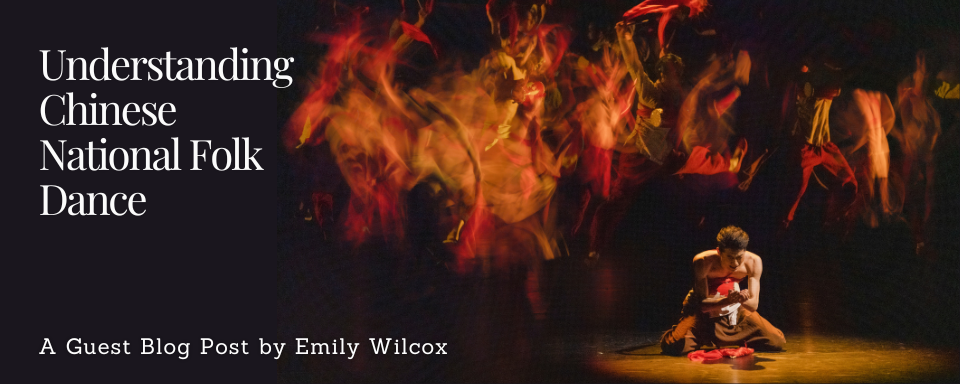
Banner photo: "Yellow Earth Yellow," choreographer: Zhang Jigang, photographer: Zhang Xidan