Q&A with Author Oded Löwenheim
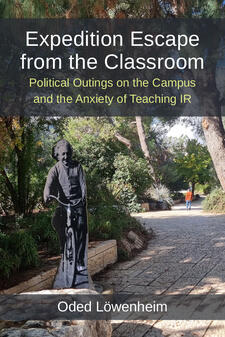
This guest author post is a Q&A with Oded Löwenheim, author of the new book Expedition Escape from the Classroom: Political Outings on the Campus and the Anxiety of Teaching IR, from the University of Michigan Press. The book is available in hardcover, paperback, and open access.
In your introduction, you talk about experiencing teaching anxiety and writer’s block— how did you work around that to write this book? Do you have any advice for others dealing with these issues?
In the fall of 2015, I began experiencing physical symptoms of anxiety before and during classes, despite being in a secure academic position. The symptoms were unmistakable, and this was coupled with a growing sense of emotional estrangement from my students. I began to cancel sessions because I feared I would not have enough to say—or worse, that I would say too much. I felt misunderstood by my students, and the familiar joy I once derived from teaching seemed to drain away.
One of the ways I worked around this anxiety was by taking my students outside the classroom on mini-expeditions. Initially, the excursions from the classroom were sporadic and spontaneous, depending mainly on my degree of anxiety on that day. These outdoor excursions allowed me to break free from the regimentation of the classroom, and I noticed a significant reduction in tension, not just for me, but for the students as well. Walking to new locations and discussing the seemingly mundane aspects of our surroundings offered me, and my students, fresh perspectives and the opportunity to engage with international relations in an embodied, non-traditional way. The movement of our bodies, the fresh air, and the sunshine—or perhaps simply the absence of walls around us—somehow greatly increased the students’ capacity for empathic listening.
To those struggling with teaching anxiety or writer’s block, I suggest finding ways to alter your environment or mode of engagement. For me, this simple act of physically leaving the classroom helped ease my anxiety and allowed me to return to writing. Additionally, my advice is not to rush the process of overcoming these challenges. Allow time for reflection, as writing—and indeed teaching—requires space for intellectual and emotional recovery. Academia often prioritizes relentless production and "excellence," but we need to ask ourselves whether this is truly sustainable or desirable. As I emphasized in the book, the goal is not always to excel but to cultivate "critical judgment" and personal meaning in our work.
In your class, you’ve taken students on mini-expeditions to several places they may not have considered examples of international relations. Could you give us an example of one of these locations and why you visited it?
One of the most intriguing places I take my students to is the British Jerusalem War Cemetery. Located just near the Mount Scopus campus, this cemetery is the resting place of over 2,500 soldiers, mainly from Britain, Australia, and New Zealand, who lost their lives during the British conquest of Palestine in World War I. Despite its proximity, the cemetery is often ignored or unnoticed by students and faculty. The cemetery serves as an ideal location to explore complex themes of international relations, empire, and war.
We visit this cemetery because it offers students a chance to reflect on the impact of imperial history and how it still resonates today. When we stand among the graves of these soldiers, who fought and died far from their homes, we engage in a discussion about the legacies of foreign intervention, colonialism, and the ways in which war can shape national identities across time and space. I challenge my students to consider the blurring of lines between past and present, local and global, when they’re confronted with the realization that these foreign soldiers contributed, in some way, to the foundation of the Hebrew University itself. This cemetery is, as I put it, "a site that blurs distinctions between what we think of as domestic and international, between us and them, between the local and the global."
Through these excursions, I hope to show students that international relations isn’t confined to textbooks or distant geopolitical conflicts. It exists in the spaces we inhabit daily—on our campus, in our cities—and we are all participants in these ongoing histories. By “IR-izing” these places, I aim to encourage students to uncover the hidden political and historical dimensions that surround them.
Can you tell us a little bit about what made you feel the Configurations: Critical Studies of World Politics series edited by Patrick Thaddeus Jackson was a good home for your book?
Since the series encourages innovative approaches to understanding world politics, particularly those that embrace critical reflexivity, it offered me the freedom to weave together autoethnography, pedagogy, and international relations in ways that traditional IR outlets may not have accommodated. Furthermore, the Configurations series doesn’t shy away from unconventional methods of inquiry. This book is as much about my personal journey through teaching anxiety and writer’s block as it is about international relations. It is a deeply personal narrative, exploring themes of vulnerability, doubt, and healing within the context of IR scholarship. I wanted a series that could handle that level of reflexivity, where the boundaries of academic writing are pushed, and where the “self” is not excluded from the analysis. I’m grateful that the series recognized the value of such an approach in the broader landscape of IR scholarship.
What do you hope readers will take away from Expedition Escape from the Classroom?
At its core, Expedition Escape from the Classroom is about rethinking the way we engage with international relations, both as an academic discipline and as part of our everyday lives. One of the key takeaways I hope readers get is the idea that the boundaries between the global and the local, between the personal and the political, are much more porous than we often think. As I note in the book, "I believe that the 'international,' the 'everyday/ordinary,' and 'personal experience' are not mutually exclusive categories."
I also hope this book encourages readers, especially educators, to embrace vulnerability and reflexivity in their teaching. So much of teaching in higher education is framed around authority and expertise, but I found that my most meaningful teaching moments came when I allowed myself to be vulnerable, to share personal narratives, and to take students outside the traditional classroom environment. This vulnerability can create deeper, more empathetic connections between students and professors, fostering a more collaborative learning experience.
Lastly, I hope that readers come away with a sense of the importance of critical observation and questioning in both teaching and research. The world is full of hidden layers of meaning, whether in a botanical garden, a war cemetery, or a sculpture on a university campus. I hope this book inspires readers to look beyond the surface and question the power structures embedded in the everyday. Finding, exposing, and sometimes even playfully inventing the international in our immediate campus environment is also a way to ‘trick’ the 'proper' of IR.
In sum, I hope readers finish this book with a renewed sense of curiosity about the world around them, as well as the tools to critically engage with it—whether they are students, teachers, or scholars in international relations.